


Page 244 - Ultimate Visual Dictionary (DK)
P. 244
THE HUMAN BODY

      Ear                                                                        STRUCTURE OF EAR


                                                                                           Temporal bone
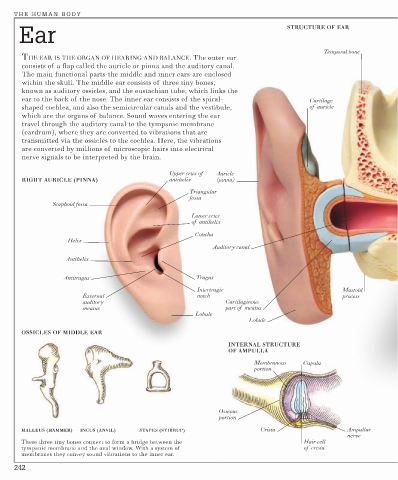
       THE EAR IS THE ORGAN OF HEARING AND BALANCE. The outer ear
       consists of a flap called the auricle or pinna and the auditory canal.
       The main functional parts-the middle and inner ears-are enclosed
       within the skull. The middle ear consists of three tiny bones,
       known as auditory ossicles, and the eustachian tube, which links the
       ear to the back of the nose. The inner ear consists of the spiral-              Cartilage
       shaped cochlea, and also the semicircular canals and the vestibule,             of  auricle
       which are the organs of balance. Sound waves entering the ear
       travel through the auditory canal to the tympanic membrane
       (eardrum), where they are converted to vibrations that are
       transmitted via the ossicles to the cochlea. Here, the vibrations
       are converted by millions of microscopic hairs into electrical
       nerve signals to be interpreted by the brain.

                                                Upper crux of    Auricle
       RIGHT AURICLE (PINNA)                    antihelix    (pinna)
                                                      Triangular
                                                      fossa
                Scaphoid fossa
                                                      Lower crux
                                                      of  antihelix
                                                       Concha
                    Helix
                                                            Auditory canal

                   Antihelix

                   Antitragus                          Tragus
                                                        Intertragic                             Mastoid
                        External                        notch                                   process
                        auditory                                Cartilaginous
                        meatus                                  part of  meatus
                                                       Lobule
                                                                      Lobule
       OSSICLES OF MIDDLE EAR
                                                                INTERNAL STRUCTURE
                                                                OF AMPULLA
                                                                        Membranous   Cupula
                                                                        portion


                                                              Osseous
                                                              portion
       MALLEUS (HAMMER)  INCUS (ANVIL)  STAPES (STIRRUP)                 Crista                  Ampullar
                                                                                                 nerve
       These three tiny bones connect to form a bridge between the                   Hair cell
       tympanic membrane and the oval window. With a system of                       of  crista
       membranes they convey sound vibrations to the inner ear.

     242

