


Page 248 - Ultimate Visual Dictionary (DK)
P. 248
THE HUMAN BODY

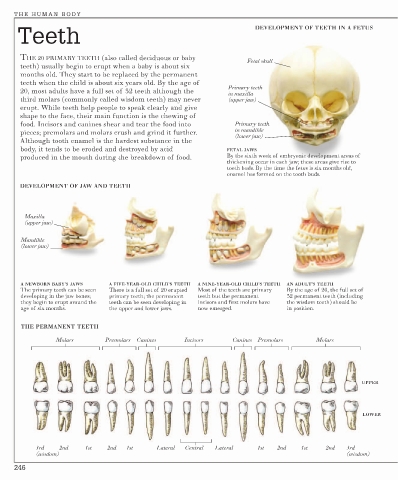
      Teeth                                                             DEVELOPMENT OF TEETH IN A FETUS


       THE 20 PRIMARY TEETH (also called deciduous or baby
                                                                      Fetal skull
       teeth) usually begin to erupt when a baby is about six
       months old. They start to be replaced by the permanent
       teeth when the child is about six years old. By the age of
                                                                Primary teeth
       20, most adults have a full set of 32 teeth although the
                                                                in maxilla
       third molars (commonly called wisdom teeth) may never    (upper jaw)
       erupt. While teeth help people to speak clearly and give
       shape to the face, their main function is the chewing of
       food. Incisors and canines shear and tear the food into    Primary teeth
       pieces; premolars and molars crush and grind it further.   in mandible
                                                                  (lower jaw)
       Although tooth enamel is the hardest substance in the
       body, it tends to be eroded and destroyed by acid        FETAL JAWS
       produced in the mouth during the breakdown of food.      By the sixth week of embryonic development areas of
                                                                thickening occur in each jaw; these areas give rise to
                                                                tooth buds. By the time the fetus is six months old,
                                                                enamel has formed on the tooth buds.
       DEVELOPMENT OF JAW AND TEETH


        Maxilla
        (upper jaw)

       Mandible
       (lower jaw)


       A NEWBORN BABY’S JAWS   A FIVE-YEAR-OLD CHILD’S TEETH  A NINE-YEAR-OLD CHILD’S TEETH  AN ADULT’S TEETH
       The primary teeth can be seen   There is a full set of 20 erupted   Most of the teeth are primary   By the age of 20, the full set of
       developing in the jaw bones;   primary teeth; the permanent   teeth but the permanent   32 permanent teeth (including
       they begin to erupt around the   teeth can be seen developing in   incisors and first molars have   the wisdom teeth) should be
       age of six months.      the upper and lower jaws.  now emerged.           in position.

       THE PERMANENT TEETH

                 Molars       Premolars Canines     Incisors      Canines Premolars      Molars


                                                                                                      UPPER


                                                                                                      LOWER


           3rd   2nd     1st   2nd  1st      Lateral  Central  Lateral  1st   2nd    1st    2nd  3rd
           (wisdom)                                                                              (wisdom)

     246

