


Page 276 - Ultimate Visual Dictionary (DK)
P. 276
GEOLOGY, GEOGRAPHY, AND METEOROLOGY
       Igneous and                                                               BASALT COLUMNS


       metamorphic rocks


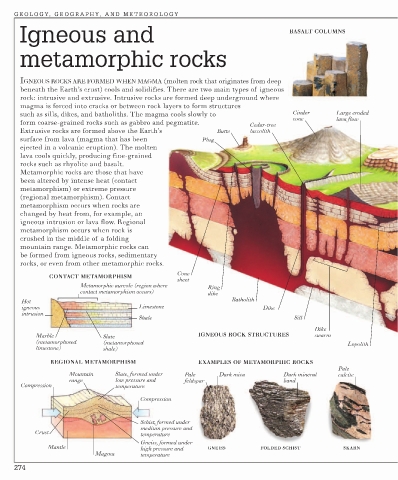
       IGNEOUS ROCKS ARE FORMED WHEN MAGMA (molten rock that originates from deep
       beneath the Earth’s crust) cools and solidifies. There are two main types of igneous
       rock: intrusive and extrusive. Intrusive rocks are formed deep underground where
       magma is forced into cracks or between rock layers to form structures
       such as sills, dikes, and batholiths. The magma cools slowly to            Cinder      Large eroded
                                                                                  cone        lava flow
       form coarse-grained rocks such as gabbro and pegmatite.
                                                                      Cedar-tree
       Extrusive rocks are formed above the Earth’s          Butte    laccolith
       surface from lava (magma that has been            Plug
       ejected in a volcanic eruption). The molten
       lava cools quickly, producing fine-grained
       rocks such as rhyolite and basalt.
       Metamorphic rocks are those that have
       been altered by intense heat (contact
       metamorphism) or extreme pressure
       (regional metamorphism). Contact
       metamorphism occurs when rocks are
       changed by heat from, for example, an
       igneous intrusion or lava flow. Regional
       metamorphism occurs when rock is
       crushed in the middle of a folding
       mountain range. Metamorphic rocks can
       be formed from igneous rocks, sedimentary
       rocks, or even from other metamorphic rocks.
                                                  Cone
               CONTACT METAMORPHISM
                                                  sheet
                       Metamorphic aureole (region where   Ring
                       contact metamorphism occurs)        dike
       Hot                                                       Batholith
       igneous                          Limestone                         Dike
       intrusion
                                        Shale                                      Sill
                                                                                        Dike
           Marble             Slate                     IGNEOUS ROCK STRUCTURES         swarm
           (metamorphosed     (metamorphosed                                                      Lopolith
           limestone)         shale)
               REGIONAL METAMORPHISM                    EXAMPLES OF METAMORPHIC ROCKS
                                                                                               Pale
                    Mountain     Slate, formed under   Pale   Dark mica         Dark mineral   calcite
                    range        low pressure and   feldspar                    band
       Compression               temperature
                                        Compression


                                        Schist, formed under
                                        medium pressure and
           Crust
                                        temperature
                                        Gneiss, formed under
              Mantle                    high pressure and   GNEISS       FOLDED SCHIST          SKARN
                           Magma        temperature
     274

