


Page 280 - Ultimate Visual Dictionary (DK)
P. 280
GEOLOGY, GEOGRAPHY, AND METEOROLOGY

       Fossils                                                  PROCESS OF FOSSILIZATION

                                                             Sea
                                                                                      Sea
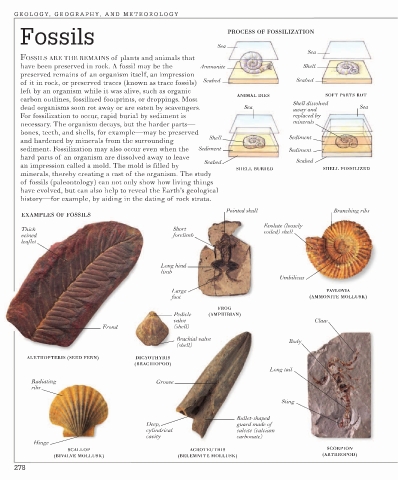
       FOSSILS ARE THE REMAINS of plants and animals that
       have been preserved in rock. A fossil may be the   Ammonite                   Shell
       preserved remains of an organism itself, an impression
       of it in rock, or preserved traces (known as trace fossils)   Seabed        Seabed
       left by an organism while it was alive, such as organic
                                                                   ANIMAL DIES             SOFT PARTS ROT
       carbon outlines, fossilized footprints, or droppings. Most
                                                                                  Shell dissolved
       dead organisms soon rot away or are eaten by scavengers.      Sea          away and           Sea
       For fossilization to occur, rapid burial by sediment is                    replaced by
                                                                                  minerals
       necessary. The organism decays, but the harder parts—
       bones, teeth, and shells, for example—may be preserved
                                                           Shell                 Sediment
       and hardened by minerals from the surrounding
       sediment. Fossilization may also occur even when the   Sediment           Sediment
       hard parts of an organism are dissolved away to leave
                                                          Seabed                   Seabed
       an impression called a mold. The mold is filled by
                                                                   SHELL BURIED            SHELL FOSSILIZED
       minerals, thereby creating a cast of the organism. The study
       of fossils (paleontology) can not only show how living things
       have evolved, but can also help to reveal the Earth’s geological
       history—for example, by aiding in the dating of rock strata.
                                                                Pointed skull                 Branching ribs
       EXAMPLES OF FOSSILS
                                                                          Evolute (loosely
       Thick-                                    Short                    coiled) shell
       veined                                    forelimb
       leaflet


                                              Long hind
                                              limb
                                                                               Umbilicus
                                                 Large                                      PAVLOVIA
                                                 foot                                  (AMMONITE MOLLUSK)
                                                              FROG
                                                 Pedicle   (AMPHIBIAN)
                                                 valve                                  Claw
                             Frond               (shell)
                                                  Brachial valve                 Body
                                                  (shell)
         ALETHOPTERIS (SEED FERN)      DICYOTHYRIS
                                      (BRACHIOPOD)
                                                                            Long tail
          Radiating                         Groove
          ribs
                                                                               Sting

                                                                   Bullet-shaped
                                          Deep,                    guard made of
                                          cylindrical              calcite (calcium
                                          cavity                   carbonate)
          Hinge
                    SCALLOP                           ACROTEUTHIS                           SCORPION
                (BIVALVE MOLLUSK)                 (BELEMNITE MOLLUSK)                      (ARTHROPOD)
     278

