


Page 282 - Ultimate Visual Dictionary (DK)
P. 282
GEOLOGY, GEOGRAPHY, AND METEOROLOGY

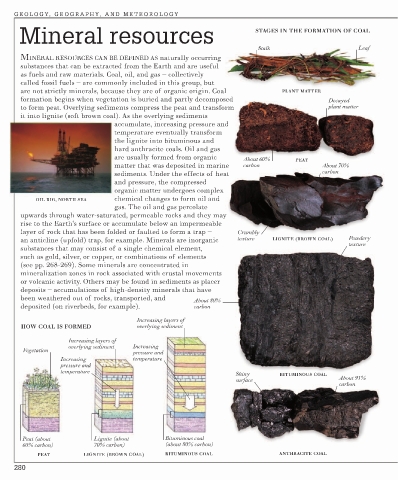
      Mineral resources                                                 STAGES IN THE FORMATION OF COAL

                                                                         Stalk                       Leaf
       MINERAL RESOURCES CAN BE DEFINED AS naturally occurring
       substances that can be extracted from the Earth and are useful
       as fuels and raw materials. Coal, oil, and gas – collectively
       called fossil fuels – are commonly included in this group, but
       are not strictly minerals, because they are of organic origin. Coal     PLANT MATTER
       formation begins when vegetation is buried and partly decomposed                     Decayed
       to form peat. Overlying sediments compress the peat and transform                    plant matter
       it into lignite (soft brown coal). As the overlying sediments
                                 accumulate, increasing pressure and
                                 temperature eventually transform
                                 the lignite into bituminous and
                                 hard anthracite coals. Oil and gas
                                 are usually formed from organic     About 60%     PEAT
                                 matter that was deposited in marine   carbon              About 70%
                                 sediments. Under the effects of heat                      carbon
                                 and pressure, the compressed
                                 organic matter undergoes complex
           OIL RIG, NORTH SEA    chemical changes to form oil and
                                 gas. The oil and gas percolate
       upwards through water-saturated, permeable rocks and they may
       rise to the Earth’s surface or accumulate below an impermeable
       layer of rock that has been folded or faulted to form a trap –    Crumbly
       an anticline (upfold) trap, for example. Minerals are inorganic   texture  LIGNITE (BROWN COAL)  Powdery
                                                                                                  texture
       substances that may consist of a single chemical element,
       such as gold, silver, or copper, or combinations of elements
       (see pp. 268-269). Some minerals are concentrated in
       mineralization zones in rock associated with crustal movements
       or volcanic activity. Others may be found in sediments as placer
       deposits – accumulations of high-density minerals that have
       been weathered out of rocks, transported, and    About 80%
       deposited (on riverbeds, for example).          carbon
                                       Increasing layers of
       HOW COAL IS FORMED              overlying sediment

                    Increasing layers of
                    overlying sediment  Increasing
       Vegetation
                                      pressure and
                  Increasing          temperature
                  pressure and
                  temperature
                                                                  Shiny        BITUMINOUS COAL
                                                                  surface                      About 95%
                                                                                               carbon


       Peat (about         Lignite (about      Bituminous coal
       60% carbon)         70% carbon)         (about 80% carbon)
           PEAT         LIGNITE (BROWN COAL)   BITUMINOUS COAL                 ANTHRACITE COAL
     280

