


Page 284 - Ultimate Visual Dictionary (DK)
P. 284
GEOLOGY, GEOGRAPHY, AND METEOROLOGY

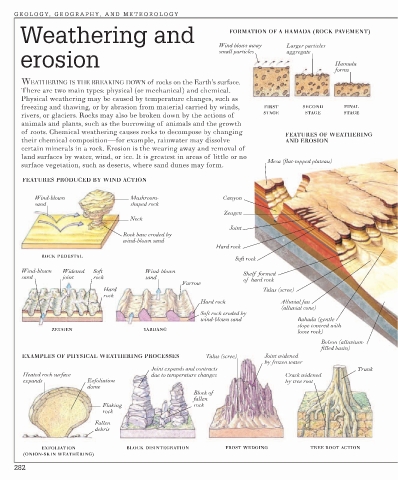
       Weathering and                                            FORMATION OF A HAMADA (ROCK PAVEMENT)

                                                              Wind blows away    Larger particles
                                                                                 aggregate
                                                              small particles
       erosion                                                                                Hamada
                                                                                              forms
       WEATHERING IS THE BREAKING DOWN of rocks on the Earth’s surface.
       There are two main types: physical (or mechanical) and chemical.
       Physical weathering may be caused by temperature changes, such as
       freezing and thawing, or by abrasion from material carried by winds,   FIRST   SECOND     FINAL
       rivers, or glaciers. Rocks may also be broken down by the actions of   STAGE   STAGE      STAGE
       animals and plants, such as the burrowing of animals and the growth
       of roots. Chemical weathering causes rocks to decompose by changing
                                                                                FEATURES OF WEATHERING
       their chemical composition—for example, rainwater may dissolve           AND EROSION
       certain minerals in a rock. Erosion is the wearing away and removal of
       land surfaces by water, wind, or ice. It is greatest in areas of little or no
                                                                           Mesa (flat-topped plateau)
       surface vegetation, such as deserts, where sand dunes may form.
       FEATURES PRODUCED BY WIND ACTION

           Wind-blown                Mushroom-                 Canyon
           sand                      shaped rock
                                                               Zeugen
                                     Neck
                                                                 Joint
                                   Rock base eroded by
                                   wind-blown sand
                                                             Hard rock
             ROCK PEDESTAL
                                                                  Soft rock
       Wind-blown   Widened   Soft       Wind-blown                  Shelf  formed
       sand       joint    rock          sand                        of  hard rock
                                                    Furrow
                              Hard                                        Talus (scree)
                              rock
                                                         Hard rock             Alluvial fan
                                                                               (alluvial cone)
                                                         Soft rock eroded by
                                                         wind-blown sand            Bahada (gentle
                                                                                    slope covered with
               ZEUGEN                    YARDANG
                                                                                    loose rock)
                                                                                          Bolson (alluvium-
                                                                                          filled basin)
       EXAMPLES OF PHYSICAL WEATHERING PROCESSES          Talus (scree)   Joint widened
                                                                          by frozen water
                                           Joint expands and contracts                              Trunk
       Heated rock surface                 due to temperature changes           Crack widened
       expands           Exfoliation                                            by tree root
                         dome
                                                       Block of
                                                       fallen
                              Flaking                  rock
                              rock
                           Fallen
                           debris


             EXFOLIATION            BLOCK DISINTEGRATION        FROST WEDGING          TREE ROOT ACTION
       (ONION-SKIN WEATHERING)
     282

