


Page 54 - Ultimate Visual Dictionary (DK)
P. 54
THE UNIVERSE

       Asteroids, comets,                                                          OPTICAL IMAGE OF
                                                                                   HALLEY’S COMET
       and meteoroids


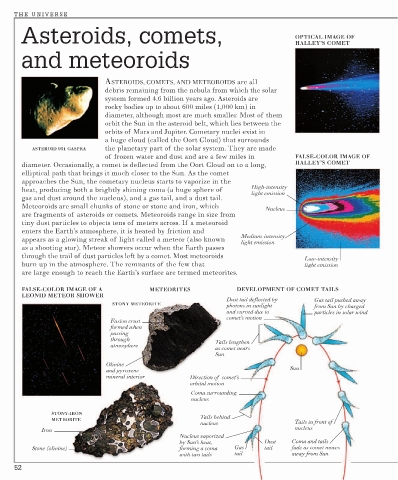
                              ASTEROIDS, COMETS, AND METEOROIDS are all
                              debris remaining from the nebula from which the solar
                              system formed 4.6 billion years ago. Asteroids are
                              rocky bodies up to about 600 miles (1,000 km) in
                              diameter, although most are much smaller. Most of them
                              orbit the Sun in the asteroid belt, which lies between the
                              orbits of Mars and Jupiter. Cometary nuclei exist in
                              a huge cloud (called the Oort Cloud) that surrounds
          ASTEROID 951 GASPRA  the planetary part of the solar system. They are made
                              of frozen water and dust and are a few miles in      FALSE-COLOR IMAGE OF
       diameter. Occasionally, a comet is deflected from the Oort Cloud on to a long,   HALLEY’S COMET
       elliptical path that brings it much closer to the Sun. As the comet
       approaches the Sun, the cometary nucleus starts to vaporize in the
                                                                       High-intensity
       heat, producing both a brightly shining coma (a huge sphere of
                                                                       light emission
       gas and dust around the nucleus), and a gas tail, and a dust tail.
       Meteoroids are small chunks of stone or stone and iron, which
                                                                           Nucleus
       are fragments of asteroids or comets. Meteoroids range in size from
       tiny dust particles to objects tens of meters across. If a meteoroid
       enters the Earth’s atmosphere, it is heated by friction and
                                                                    Medium-intensity
       appears as a glowing streak of light called a meteor (also known
                                                                    light emission
       as a shooting star). Meteor showers occur when the Earth passes
       through the trail of dust particles left by a comet. Most meteoroids
                                                                                      Low-intensity
       burn up in the atmosphere. The remnants of the few that                        light emission
       are large enough to reach the Earth’s surface are termed meteorites.
       FALSE-COLOR IMAGE OF A              METEORITES              DEVELOPMENT OF COMET TAILS
       LEONID METEOR SHOWER
                                                                Dust tail deflected by   Gas tail pushed away
                                STONY METEORITE                 photons in sunlight     from Sun by charged
                                                                and curved due to       particles in solar wind
                                                                comet’s motion
                                Fusion crust
                                formed when
                                passing
                                through
                                                             Tails lengthen
                                atmosphere
                                                             as comet nears
                                                             Sun
                              Olivine
                              and pyroxene                                        Sun
                              mineral interior        Direction of  comet’s
                                                      orbital motion
                                                      Coma surrounding
                                                      nucleus
               STONY-IRON
                                                         Tails behind
               METEORITE
                                                         nucleus                   Tails in front of
                                                                                   nucleus
             Iron
                                                   Nucleus vaporized
                                                   by Sun’s heat,         Dust    Coma and tails
          Stone (olivine)                          forming a coma   Gas   tail    fade as comet moves
                                                   with two tails  tail           away from Sun
     52

