


Page 52 - Ultimate Visual Dictionary (DK)
P. 52
THE UNIVERSE

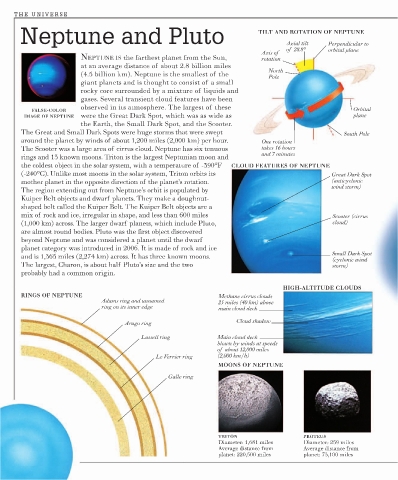
       Neptune and Pluto                                                 TILT AND ROTATION OF NEPTUNE
                                                                                 Axial tilt
                                                                                 of  28.8°  Perpendicular to
                                                                                            orbital plane
                                                                          Axis of
                       NEPTUNE IS the farthest planet from the Sun,       rotation
                       at an average distance of about 2.8 billion miles
                                                                            North
                       (4.5 billion km). Neptune is the smallest of the
                                                                            Pole
                       giant planets and is thought to consist of a small
                       rocky core surrounded by a mixture of liquids and
                       gases. Several transient cloud features have been
                       observed in its atmosphere. The largest of these
          FALSE-COLOR                                                                              Orbital
        IMAGE OF NEPTUNE  were the Great Dark Spot, which was as wide as                           plane
                       the Earth, the Small Dark Spot, and the Scooter.
       The Great and Small Dark Spots were huge storms that were swept                           South Pole
       around the planet by winds of about 1,200 miles (2,000 km) per hour.   One rotation
       The Scooter was a large area of cirrus cloud. Neptune has six tenuous   takes 16 hours
                                                                          and 7 minutes
       rings and 13 known moons. Triton is the largest Neptunian moon and
       the coldest object in the solar system, with a temperature of -390°F   CLOUD FEATURES OF NEPTUNE
       (-240°C). Unlike most moons in the solar system, Triton orbits its                    Great Dark Spot
       mother planet in the opposite direction of the planet’s rotation.                     (anticyclonic
                                                                                             wind storm)
       The region extending out from Neptune’s orbit is populated by
       Kuiper Belt objects and dwarf planets. They make a doughnut-
       shaped belt called the Kuiper Belt. The Kuiper Belt objects are a
       mix of rock and ice, irregular in shape, and less than 600 miles                      Scooter (cirrus
       (1,000 km) across. The larger dwarf planets, which include Pluto,                     cloud)
       are almost round bodies. Pluto was the first object discovered
       beyond Neptune and was considered a planet until the dwarf
       planet category was introduced in 2006. It is made of rock and ice
                                                                                             Small Dark Spot
       and is 1,365 miles (2,274 km) across. It has three known moons.
                                                                                             (cyclonic wind
       The largest, Charon, is about half Pluto’s size and the two                           storm)
       probably had a common origin.
                                                                                HIGH-ALTITUDE CLOUDS
       RINGS OF NEPTUNE                                       Methane cirrus clouds
                             Adams ring and unnamed           25 miles (40 km) above
                             ring on its inner edge           main cloud deck
                                                                   Cloud shadow
                                    Arago ring
                                        Lassell ring         Main cloud deck
                                                             blown by winds at speeds
                                                             of  about 12,000 miles
                                            Le Verrier ring  (2,000 km/h)
                                                              MOONS OF NEPTUNE
                                                Galle ring


                                                              TRITON                 PROTEUS
                                                              Diameter: 1,681 miles   Diameter: 259 miles
                                                              Average distance from   Average distance from
                                                              planet: 220,500 miles  planet: 73,100 miles

