


Page 74 - Ultimate Visual Dictionary (DK)
P. 74
PREHISTORIC EAR TH

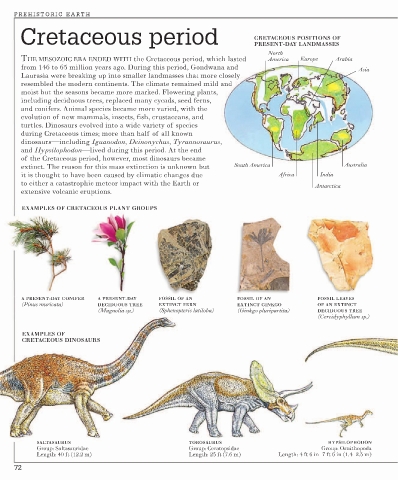
       Cretaceous period                                                CRETACEOUS POSITIONS OF
                                                                        PRESENT-DAY LANDMASSES
                                                                           North
       THE MESOZOIC ERA ENDED WITH the Cretaceous period, which lasted     America  Europe    Arabia
       from 146 to 65 million years ago. During this period, Gondwana and
                                                                                                     Asia
       Laurasia were breaking up into smaller landmasses that more closely
       resembled the modern continents. The climate remained mild and
       moist but the seasons became more marked. Flowering plants,
       including deciduous trees, replaced many cycads, seed ferns,
       and conifers. Animal species became more varied, with the
       evolution of new mammals, insects, fish, crustaceans, and
       turtles. Dinosaurs evolved into a wide variety of species
       during Cretaceous times; more than half of all known
       dinosaurs—including Iguanodon, Deinonychus, Tyrannosaurus,
       and Hypsilophodon—lived during this period. At the end
       of the Cretaceous period, however, most dinosaurs became
       extinct. The reason for this mass extinction is unknown but    South America              Australia
       it is thought to have been caused by climatic changes due              Africa      India
       to either a catastrophic meteor impact with the Earth or
                                                                                         Antarctica
       extensive volcanic eruptions.

       EXAMPLES OF CRETACEOUS PLANT GROUPS


       A PRESENT-DAY CONIFER  A PRESENT-DAY   FOSSIL OF AN         FOSSIL OF AN          FOSSIL LEAVES
       (Pinus muricata)     DECIDUOUS TREE   EXTINCT FERN          EXTINCT GINKGO        OF AN EXTINCT
                            (Magnolia sp.)   (Sphenopteris latiloba)  (Ginkgo pluripartita)  DECIDUOUS TREE
                                                                                         (Cercidyphyllum sp.)

       EXAMPLES OF
       CRETACEOUS DINOSAURS


           SALTASAURUS                               TOROSAURUS                             HYPSILOPHODON
           Group: Saltasauridae                      Group: Ceratopsidae                  Group: Ornithopoda
           Length: 40 ft (12.2 m)                    Length: 25 ft (7.6 m)    Length: 4 ft 6 in–7 ft 6 in (1.4–2.3 m)

     72

