


Page 70 - Ultimate Visual Dictionary (DK)
P. 70
PREHISTORIC EAR TH

       Triassic period                                                  TRIASSIC POSITIONS OF
                                                                        PRESENT-DAY LANDMASSES
                                                                           North
       THE TRIASSIC PERIOD (250–200 million years ago) marked the beginning
                                                                           America  Europe   Asia
       of what is known as the Age of the Dinosaurs (the Mesozoic era). During
       this period, the present-day continents were massed together, forming
       one huge continent known as Pangaea. This landmass experienced
       extremes of climate, with lush green areas around the coast
       or by lakes and rivers, and arid deserts in the interior. The
       only forms of plant life were nonflowering plants, such
       as conifers, ferns, cycads, and ginkgos; flowering plants had
       not yet evolved. The principal forms of animal life included
       diverse, often gigantic, amphibians, rhynchosaurs
       (“beaked lizards”), and primitive crocodilians. Dinosaurs
       first appeared about 230 million years ago, at the beginning
       of the Late Triassic period. Among the earliest dinosaurs   South
                                                             America
       were the carnivorous (flesh-eating) herrerasaurids, such as
       Herrerasaurus and Staurikosaurus. Early herbivorous (plant-eating)    Africa
       dinosaurs first appeared in Late Triassic times and included Plateosaurus                 Australia
                                                                              Antarctica
       and Technosaurus. By the end of the Triassic period, dinosaurs dominated
                                                                                           India
       Pangaea, possibly contributing to the extinction of many other reptiles.

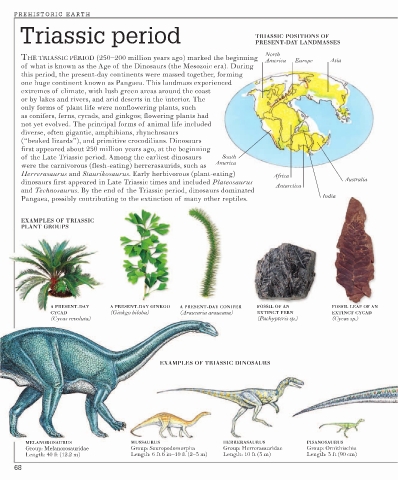
       EXAMPLES OF TRIASSIC
       PLANT GROUPS


               A PRESENT-DAY    A PRESENT-DAY GINKGO  A PRESENT-DAY CONIFER  FOSSIL OF AN    FOSSIL LEAF OF AN
               CYCAD            (Ginkgo biloba)    (Araucaria araucana)  EXTINCT FERN        EXTINCT CYCAD
               (Cycas revoluta)                                         (Pachypteris sp.)    (Cycas sp.)


                                             EXAMPLES OF TRIASSIC DINOSAURS


        MELANOROSAURUS               MUSSAURUS                 HERRERASAURUS          PISANOSAURUS
        Group: Melanorosauridae      Group: Sauropodomorpha    Group: Herrerasauridae   Group: Ornithischia
        Length: 40 ft (12.2 m)       Length: 6 ft 6 in–10 ft (2–3 m)  Length: 10 ft (3 m)  Length: 3 ft (90 cm)

     68

