


Page 76 - Ultimate Visual Dictionary (DK)
P. 76
PREHISTORIC EAR TH

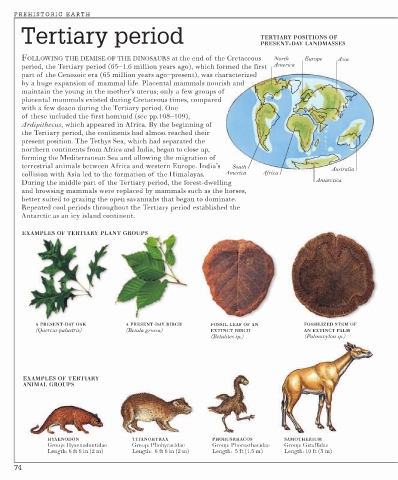
       Tertiary period                                                   TERTIARY POSITIONS OF
                                                                         PRESENT-DAY LANDMASSES

       FOLLOWING THE DEMISE OF THE DINOSAURS at the end of the Cretaceous    North    Europe   Asia
       period, the Tertiary period (65–1.6 million years ago), which formed the first   America
       part of the Cenozoic era (65 million years ago–present), was characterized
       by a huge expansion of mammal life. Placental mammals nourish and
       maintain the young in the mother’s uterus; only a few groups of
       placental mammals existed during Cretaceous times, compared
       with a few dozen during the Tertiary period. One
       of these included the first hominid (see pp.108–109),
       Ardipithecus, which appeared in Africa. By the beginning of
       the Tertiary period, the continents had almost reached their
       present position. The Tethys Sea, which had separated the
       northern continents from Africa and India, began to close up,
       forming the Mediterranean Sea and allowing the migration of
       terrestrial animals between Africa and western Europe. India’s   South                Australia
       collision with Asia led to the formation of the Himalayas.   America  Africa
                                                                                         Antarctica
       During the middle part of the Tertiary period, the forest-dwelling
       and browsing mammals were replaced by mammals such as the horses,
       better suited to grazing the open savannahs that began to dominate.
       Repeated cool periods throughout the Tertiary period established the
       Antarctic as an icy island continent.

       EXAMPLES OF TERTIARY PLANT GROUPS


           A PRESENT-DAY OAK        A PRESENT-DAY BIRCH     FOSSIL LEAF OF AN        FOSSILIZED STEM OF
           (Quercus palustris)      (Betula grossa)         EXTINCT BIRCH            AN EXTINCT PALM
                                                            (Betulites sp.)          (Palmoxylon sp.)


       EXAMPLES OF TERTIARY
       ANIMAL GROUPS


              HYAENODON               TITANOHYRAX           PHORUSRHACOS        SAMOTHERIUM
              Group: Hyaenodontidae   Group: Pliohyracidae   Group: Phorusrhacidae   Group: Giraffidae
              Length: 6 ft 6 in (2 m)  Length:  6 ft 6 in (2 m)  Length:  5 ft (1.5 m)  Length: 10 ft (3 m)

     74

