


Page 80 - Ultimate Visual Dictionary (DK)
P. 80
PREHISTORIC EAR TH

       Early signs of life

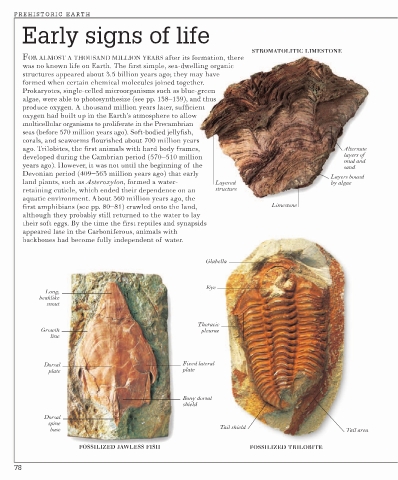
                                                                       STROMATOLITIC LIMESTONE
       FOR ALMOST A THOUSAND MILLION YEARS after its formation, there
       was no known life on Earth. The first simple, sea-dwelling organic
       structures appeared about 3.5 billion years ago; they may have
       formed when certain chemical molecules joined together.
       Prokaryotes, single-celled microorganisms such as blue-green
       algae, were able to photosynthesize (see pp. 138–139), and thus
       produce oxygen. A thousand million years later, sufficient
       oxygen had built up in the Earth’s atmosphere to allow
       multicellular organisms to proliferate in the Precambrian
       seas (before 570 million years ago). Soft-bodied jellyfish,
       corals, and seaworms flourished about 700 million years
       ago. Trilobites, the first animals with hard body frames,                                 Alternate
       developed during the Cambrian period (570–510 million                                     layers of
                                                                                                 mud and
       years ago). However, it was not until the beginning of the                                sand
       Devonian period (409–363 million years ago) that early
                                                                                             Layers bound
       land plants, such as Asteroxylon, formed a water-     Layered                         by algae
       retaining cuticle, which ended their dependence on an   structure
       aquatic environment. About 360 million years ago, the
       first amphibians (see pp. 80–81) crawled onto the land,              Limestone
       although they probably still returned to the water to lay
       their soft eggs. By the time the first reptiles and synapsids
       appeared late in the Carboniferous, animals with
       backbones had become fully independent of water.


                                                          Glabella


                                                          Eye
              Long,
            beaklike
              snout

                                                        Thoracic
            Growth                                       pleurae
               line


             Dorsal                                 Fixed lateral
              plate                                 plate


                                                    Bony dorsal
                                                    shield
             Dorsal
              spine
               base                                           Tail shield                        Tail area

                       FOSSILIZED JAWLESS FISH                        FOSSILIZED TRILOBITE


     78

