


Page 10 - The Complete Dog Breed Book Choose the Perfect Dog for You, New Edition (DK)
P. 10
10     INTRODUC TION T O DOG S


        bone. Four large canine teeth at the front of a dog’s mouth   TALL AND SHORT
        are used for grabbing and biting prey, while the sides of the   The extreme diversity of dog breeds
        jaw include specially modified teeth, the carnassials, which   is illustrated by the differences in leg
                                                         length between an Irish Wolfhound
        the dog uses for shearing off meat. Dogs have a spacious   and a Wirehaired Dachshund.
        stomach for the storage of large quantities of food and,
        since meat can be digested rapidly, a short intestinal tract.   surroundings and the area of the
          Dogs have a wide-angled field of vision that functions    brain that interprets smells is
        best at long distance, and they are extremely sensitive to   around 40 times larger than the
        movement. Out of the corner of an eye, a dog can pick up the   corresponding area in a human
        flicker of a rabbit a hundred feet away, but at close range,   brain. Dogs’ noses are packed
        canine vision is less efficient, which is why a dog may fail to   with far more scent-receptive
        spot a toy on the ground in front of his nose. Dogs have little   cells than humans; while a person
        use for sophisticated color vision, and their eyes have far   has an estimated 5 million scent
        fewer color-receptive cells than those of humans.  receptors, a small dog may have closer to 130 million.
          Sharp hearing and the ability to pinpoint the direction of   In breeds renowned for their scenting ability, such as
        sounds is essential to wild hunting dogs. Breeds with erect   hounds, the number of scent receptors may be as many
        ears shaped like those of the wolf are likely to have more   as 200–300 million.
        cute hearing than breeds with drop ears, which rely more on   Unlike humans, dogs do not have sweat glands in their
        sight or scent when hunting. A dog’s highly sensitive ears   skin except on the bottoms of their paws. To cool down,
        allow it to pick up sounds at a far higher frequency than    dogs must pant, tongue hanging out. The tongue produces
        can be heard by humans. Smell is the most important of    copious saliva, some of which evaporates, so this helps
        all canine senses. Sniffing is the way a dog reads its   reduce body temperature.

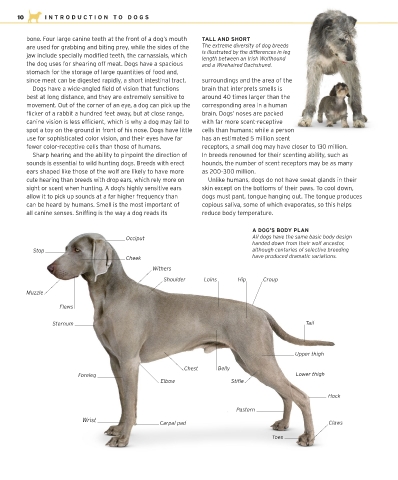
                                                                       A DOG’S BODY PLAN
                                    Occiput                            All dogs have the same basic body design
                                                                       handed down from their wolf ancestor,
          Stop                                                         although centuries of selective breeding
                                    Cheek                              have produced dramatic variations.
                                           Withers
                                              Shoulder    Loins    Hip    Croup
        Muzzle

                  Flews

                Sternum                                                               Tail


                                                                                   Upper thigh
                                                    Chest     Belly
                       Foreleg                                                     Lower thigh
                                              Elbow              Stifle
                                                                                            Hock
                                                                   Pastern
                        Wrist                Carpal pad                                     Claws

                                                                             Toes


   US_008-011_What_is_a_dog.indd   10                                                                07/11/19   2:42 PM

