


Page 9 - The Complete Dog Breed Book Choose the Perfect Dog for You, New Edition (DK)
P. 9
WHA T IS A DOG ?        9


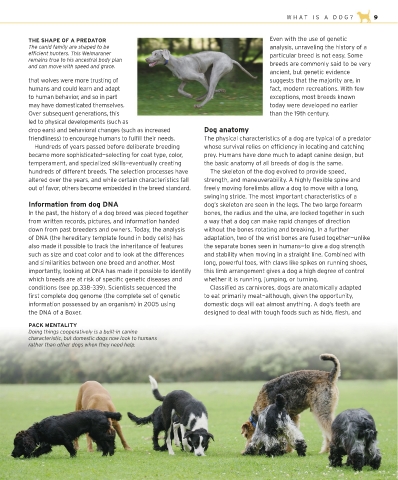
         THE SHAPE OF A PREDATOR                                            Even with the use of genetic
         The canid family are shaped to be                                  analysis, unraveling the history of a
         efficient hunters. This Weimaraner                                 particular breed is not easy. Some
         remains true to his ancestral body plan
         and can move with speed and grace.                                 breeds are commonly said to be very
                                                                            ancient, but genetic evidence
         that wolves were more trusting of                                  suggests that the majority are, in
         humans and could learn and adapt                                   fact, modern recreations. With few
         to human behavior, and so in part                                  exceptions, most breeds known
         may have domesticated themselves.                                  today were developed no earlier
         Over subsequent generations, this                                  than the 19th century.
         led to physical developments (such as
         drop ears) and behavioral changes (such as increased   Dog anatomy
         friendliness) to encourage humans to fulfill their needs.  The physical characteristics of a dog are typical of a predator
           Hundreds of years passed before deliberate breeding   whose survival relies on efficiency in locating and catching
         became more sophisticated—selecting for coat type, color,   prey. Humans have done much to adapt canine design, but
         temperament, and specialized skills—eventually creating   the basic anatomy of all breeds of dog is the same.
         hundreds of different breeds. The selection processes have   The skeleton of the dog evolved to provide speed,
         altered over the years, and while certain characteristics fall   strength, and maneuverability. A highly flexible spine and
         out of favor, others become embedded in the breed standard.   freely moving forelimbs allow a dog to move with a long,
                                                          swinging stride. The most important characteristics of a
         Information from dog DNA                         dog’s skeleton are seen in the legs. The two large forearm
         In the past, the history of a dog breed was pieced together   bones, the radius and the ulna, are locked together in such
         from written records, pictures, and information handed    a way that a dog can make rapid changes of direction
         down from past breeders and owners. Today, the analysis    without the bones rotating and breaking. In a further
         of DNA (the hereditary template found in body cells) has    adaptation, two of the wrist bones are fused together—unlike
         also made it possible to track the inheritance of features   the separate bones seen in humans—to give a dog strength
         such as size and coat color and to look at the differences    and stability when moving in a straight line. Combined with
         and similarities between one breed and another. Most   long, powerful toes, with claws like spikes on running shoes,
         importantly, looking at DNA has made it possible to identify   this limb arrangement gives a dog a high degree of control
         which breeds are at risk of specific genetic diseases and   whether it is running, jumping, or turning.
         conditions (see pp.338–339). Scientists sequenced the    Classified as carnivores, dogs are anatomically adapted
         first complete dog genome (the complete set of genetic   to eat primarily meat—although, given the opportunity,
         information possessed by an organism) in 2005 using    domestic dogs will eat almost anything. A dog’s teeth are
         the DNA of a Boxer.                              designed to deal with tough foods such as hide, flesh, and
         PACK MENTALITY
         Doing things cooperatively is a built-in canine
         characteristic, but domestic dogs now look to humans
         rather than other dogs when they need help.


   US_008-011_What_is_a_dog.indd   9                                                                27/09/19   10:59 AM

