


Page 12 - The Complete Dog Breed Book Choose the Perfect Dog for You, New Edition (DK)
P. 12
12     INTRODUC TION T O DOG S


        Breeds and breed groups
        Although many distinct varieties of dog were recognized   function, but no two systems are exactly the same. Both the
        earlier, until the early 20th century, their breeding was not   American and UK Kennel Clubs recognize seven groups,
        necessarily strictly controlled. When dog breeders started    while the FCI has 10. The number of individual breeds
        to cooperate with one another and form clubs, they were   recognized by these organizations also varies.
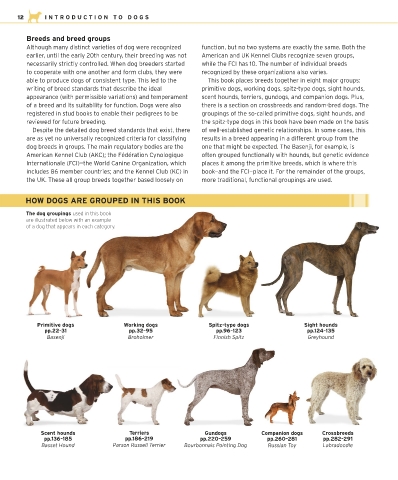
        able to produce dogs of consistent type. This led to the   This book places breeds together in eight major groups:
        writing of breed standards that describe the ideal   primitive dogs, working dogs, spitz-type dogs, sight hounds,
        appearance (with permissible variations) and temperament   scent hounds, terriers, gundogs, and companion dogs. Plus,
        of a breed and its suitability for function. Dogs were also   there is a section on crossbreeds and random-bred dogs. The
        registered in stud books to enable their pedigrees to be   groupings of the so-called primitive dogs, sight hounds, and
        reviewed for future breeding.                    the spitz-type dogs in this book have been made on the basis
          Despite the detailed dog breed standards that exist, there   of well-established genetic relationships. In some cases, this
        are as yet no universally recognized criteria for classifying   results in a breed appearing in a different group from the
        dog breeds in groups. The main regulatory bodies are the   one that might be expected. The Basenji, for example, is
        American Kennel Club (AKC); the Fédération Cynologique   often grouped functionally with hounds, but genetic evidence
        Internationale (FCI)—the World Canine Organization, which   places it among the primitive breeds, which is where this
        includes 86 member countries; and the Kennel Club (KC) in   book—and the FCI—place it. For the remainder of the groups,
        the UK. These all group breeds together based loosely on   more traditional, functional groupings are used.


        HOW DOGS ARE GROUPED IN THIS BOOK
        The dog groupings used in this book
        are illustrated below with an example
        of a dog that appears in each category.


           Primitive dogs          Working dogs            Spitz-type dogs           Sight hounds
             pp.22–31                pp.32–95                pp.96–123                pp.124–135
              Basenji                Broholmer              Finnish Spitz              Greyhound


            Scent hounds             Terriers             Gundogs         Companion dogs   Crossbreeds
             pp.136–185             pp.186–219           pp.220–259        pp.260–281      pp.282–291
             Basset Hound       Parson Russell Terrier  Bourbonnais Pointing Dog   Russian Toy  Labradoodle


   US_012-013_Breed_groups.indd   12                                                                12/09/19   12:08 PM

