


Page 311 - The Complete Dog Breed Book Choose the Perfect Dog for You, New Edition (DK)
P. 311
GOOD BEHA VIOR          311


                                                          Barking
                                                          Often puppies will “find their voice” at around 6 months
                                                          of age. Puppy-yapping can be amusing, and although it is
                                                          tempting to encourage this new behavior, it is not advisable.
                                                          As your puppy matures, both you and your neighbors will
                                                          become weary of persistent barking. If your puppy is prone
                                                          to barking at certain moments of high excitement—for
                                                          example, during a game—then use a leash to control his
                                                          behavior. Give him what he wants only when he is quiet.
                                                          If your puppy tends to bark excitedly when you are about
                                                          to do something, such as prepare his dinner or get ready
                                                          for a walk, stop what you are doing until he is quiet. If
                                                          necessary, sit down calmly on the couch until he has stopped
                                                          barking completely. It is worth spending a few extra minutes
                                                          getting your puppy calm before going out of the door for
                                                          a walk. Your puppy will realize quickly that barking is
                                                          completely counterproductive when it comes to getting
                                                          what he wants, whereas waiting quietly is always rewarded.


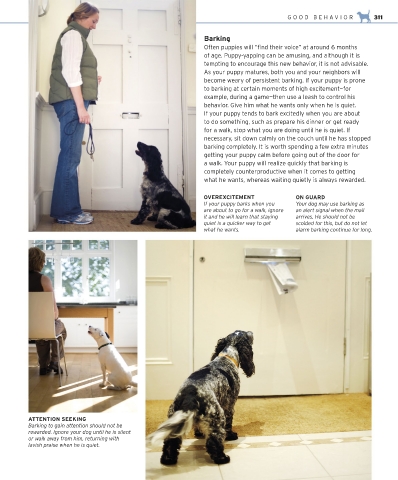
                                                          OVEREXCITEMENT           ON GUARD
                                                          If your puppy barks when you   Your dog may use barking as
                                                          are about to go for a walk, ignore   an alert signal when the mail
                                                          it and he will learn that staying   arrives. He should not be
                                                          quiet is a quicker way to get   scolded for this, but do not let
                                                          what he wants.           alarm barking continue for long.


         ATTENTION SEEKING
         Barking to gain attention should not be
         rewarded. Ignore your dog until he is silent
         or walk away from him, returning with
         lavish praise when he is quiet.


   US_310-311_Good_Behaviour3.indd   311                                                             10/09/19   3:42 PM

