


Page 319 - The Complete Dog Breed Book Choose the Perfect Dog for You, New Edition (DK)
P. 319
S OCIALIZ A TION       319


         Learning to be left alone
         Everyone wants to spend a great deal of time with a new
         puppy in the first few weeks after his arrival. The general
         fuss and attention, combined with socialization, usually
         mean that the puppy is never alone for more than a few of
         his waking moments. As he gets older and stops receiving
         such constant attention, he may become anxious at being
         left alone. Part of his socialization should include teaching
         him to accept being on his own.
           Choose a time when your puppy is ready for sleep. Take
         him outside to relieve himself before guiding him to his bed
         and calmly leaving the room. Shut the door behind you and
         ignore whining and barking until he gives up and falls asleep.
         This exercise should be repeated until the puppy has learned
         to settle quietly on his own for a few hours.
           Puppies should be discouraged from following their
         owners around everywhere they go. Make a point of shutting
         doors behind you as you move around the house so that
         your puppy cannot always come with you. At first, go back
         to him quickly and reassure him, so that he knows he has not
         been abandoned and that you never stay away for long. He
         will soon learn that there is no need to become worried or
         nervous at being left alone.
           Never scold your dog for something that has happened
         in your absence. If you leave your puppy for half an hour
         and return to find he has chewed his blanket, do not punish
         him. Dogs associate events that occur very close together:
         scolding your puppy will teach him to be afraid of you
         coming home, not that chewing a blanket is wrong.
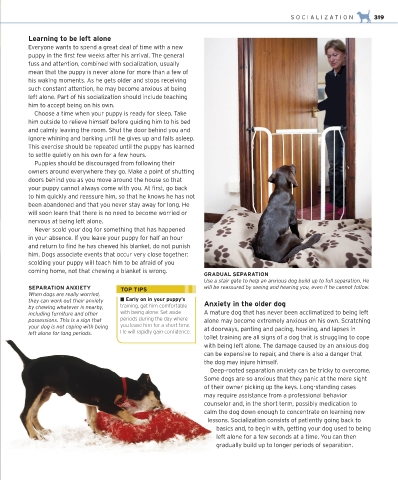
                                                          GRADUAL SEPARATION
                                                          Use a stair gate to help an anxious dog build up to full separation. He
         SEPARATION ANXIETY        TOP TIPS               will be reassured by seeing and hearing you, even if he cannot follow.
         When dogs are really worried,
         they can work out their anxiety   ■ Early on in your puppy’s    Anxiety in the older dog
         by chewing whatever is nearby,   training, get him comfortable
         including furniture and other   with being alone. Set aside   A mature dog that has never been acclimatized to being left
         possessions. This is a sign that   periods during the day where   alone may become extremely anxious on his own. Scratching
         your dog is not coping with being   you leave him for a short time.   at doorways, panting and pacing, howling, and lapses in
         left alone for long periods.  He will rapidly gain confidence.
                                                          toilet training are all signs of a dog that is struggling to cope
                                                          with being left alone. The damage caused by an anxious dog
                                                          can be expensive to repair, and there is also a danger that
                                                          the dog may injure himself.
                                                           Deep-rooted separation anxiety can be tricky to overcome.
                                                          Some dogs are so anxious that they panic at the mere sight
                                                          of their owner picking up the keys. Long-standing cases
                                                          may require assistance from a professional behavior
                                                          counselor and, in the short term, possibly medication to
                                                          calm the dog down enough to concentrate on learning new
                                                           lessons. Socialization consists of patiently going back to
                                                             basics and, to begin with, getting your dog used to being
                                                             left alone for a few seconds at a time. You can then
                                                             gradually build up to longer periods of separation.


   US_318-319_Learning_2B_Alone.indd   319                                                           10/09/19   3:42 PM

