


Page 320 - The Complete Dog Breed Book Choose the Perfect Dog for You, New Edition (DK)
P. 320
320     C ARE AND TR AINING


        TRAINING YOUR DOG


        To enjoy spending time with your dog, both in the house and
        outdoors, you need to train him to be well behaved. Training
        strengthens the bond between the two of you and provides your
        dog with some of the mental stimulation he craves. If you learn
        how to communicate with your dog and read his body language,
        it will make teaching him much easier and more satisfying.


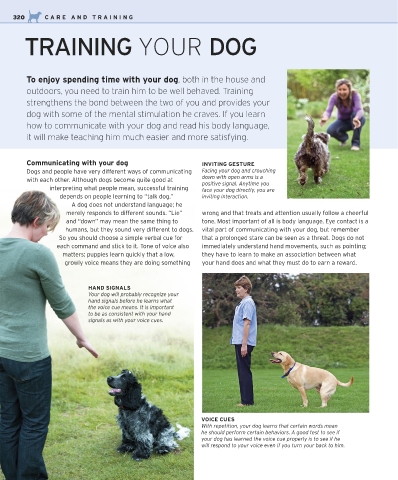
        Communicating with your dog                      INVITING GESTURE
        Dogs and people have very different ways of communicating   Facing your dog and crouching
        with each other. Although dogs become quite good at   down with open arms is a
                                                         positive signal. Anytime you
               interpreting what people mean, successful training   face your dog directly, you are
                  depends on people learning to “talk dog.”  inviting interaction.
                     A dog does not understand language; he
                   merely responds to different sounds. “Lie”   wrong and that treats and attention usually follow a cheerful
                   and “down” may mean the same thing to   tone. Most important of all is body language. Eye contact is a
                   humans, but they sound very different to dogs.   vital part of communicating with your dog, but remember
                 So you should choose a simple verbal cue for   that a prolonged stare can be seen as a threat. Dogs do not
                 each command and stick to it. Tone of voice also   immediately understand hand movements, such as pointing;
                  matters; puppies learn quickly that a low,   they have to learn to make an association between what
                   growly voice means they are doing something   your hand does and what they must do to earn a reward.


                          HAND SIGNALS
                          Your dog will probably recognize your
                          hand signals before he learns what
                          the voice cue means. It is important
                          to be as consistent with your hand
                          signals as with your voice cues.


                                                         VOICE CUES
                                                         With repetition, your dog learns that certain words mean
                                                         he should perform certain behaviors. A good test to see if
                                                         your dog has learned the voice cue properly is to see if he
                                                         will respond to your voice even if you turn your back to him.


   US_320-321_178795_Training_Your_dog.indd   320                                                   10/09/19   11:48 AM

