


Page 162 - DK Eyewitness Travel - Guides Ultimate Food Journeys
P. 162
160     THE MIDDLE EAST AND AFRICA


                        The Flavors of


                        The Middle East and Africa


                        Mention the Middle East in a culinary context and most people think of kebabs and kofte. In fact, the region’s cuisine is

                        as rich, colorful, and ancient as its history. The region is also renowned for its hospitality, where “a guest is a gift from
                        God”; travelers often find themselves invited to sample dishes where they taste best: in the home. In contrast to the
                        Middle East’s homogenous approach, Africa’s 61 territories have enormously varied cuisines, offering surprising delights.


                        Mesopotamia, as it was known in ancient times, is called the “Cradle   and the roasting of meat on fires – the world’s first kebabs. The
                        of Civilization,” and it was here, around 7,000 years ago, that man   Persians brought rice and poultry, sometimes combining both
                        first turned from nomadic hunter-gatherer into settled farmer. Part    into such sumptuous dishes as khoresh-e fesejan and polo. The
                        of a wider region known as the “Fertile Crescent,” which stretched   Ottomans introduced the fine art of sweet and savory pastry,
                        sicklelike from North Africa’s Nile along the Mediterranean coast all   conspiring to make such delectable delicacies as baklava, as well
                        the way to the Persian Gulf, this was the home of the Biblical Garden   as the tradition of meze – dining on little dishes such as falafel and
                        of Eden, and it was long known as the “land of milk and honey.”   kibbeh nayyeh – and the fashion for drinking coffee.
                          It was the region’s abundance of food and, in particular, wheat
                        that first caught the covetous eye of the Romans, who occupied the   The Phenomenon of the Souk
                                               area in the 2nd century AD. Hot on   Nowhere are the region’s riches more evident than in the souks,
                  This was the home of the
                                               the heels of the Romans came other   each one a labyrinthine warren of stands selling the finest local
                  Biblical Garden of Eden,     powers who introduced their own   goods and produce. There’s rice and waxy saffron from the Caspian
               and was long known as the       culinary traditions but also adopted   Sea, honey-sweet soft fruits including translucent apricots from
                 “land of milk and honey.”     the local ones. Later, they carried this   Lebanon, plump cherries, quinces, and melons from Iran, fragrant
                                               culinary combination with them as   figs from Turkey, and beautiful artichokes, peppers, okra, zucchini,
                        they swept east or west, bequeathing the whole region an unusual
                        culinary homogeneity. Like the magnificent ancient monuments of
                        the Middle East, its foods are a legacy of the powers that passed
                        through it. With the Arabs in the 7th century came dates and nuts
                        as well as exotic spices from seafaring merchants, bringing
                        turmeric, cardamom, cumin, peppercorns, cloves, and allspice
                        from India and Southeast Asia. With the Mongols came dumplings


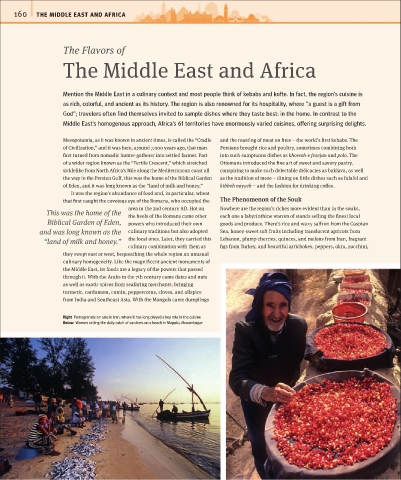
                        Right  Pomegranate on sale in Iran, where it has long played a key role in the cuisine
                        Below  Women selling the daily catch of sardines on a beach in Maputo, Mozambique

