


Page 166 - DK Eyewitness Travel - Guides Ultimate Food Journeys
P. 166
164     THE MIDDLE EAST AND AFRICA


                                                                                         ISFAHAN


            ISFAHAN IRAN

            Khoresh-e Fesenjan in Isfahan


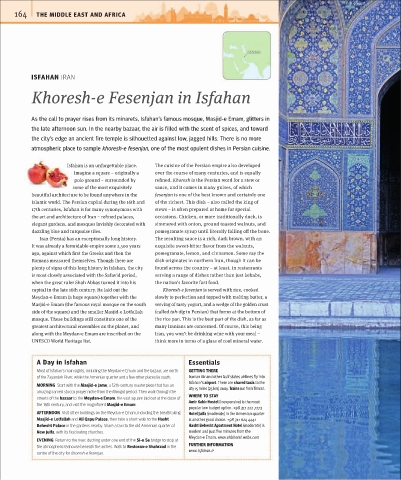
            As the call to prayer rises from its minarets, Isfahan’s famous mosque, Masjid-e Emam, glitters in
            the late afternoon sun. In the nearby bazaar, the air is filled with the scent of spices, and toward
            the city’s edge an ancient fire temple is silhouetted against low, jagged hills. There is no more
            atmospheric place to sample khoresh-e fesenjan, one of the most opulent dishes in Persian cuisine.


                         Isfahan is an unforgettable place.   The cuisine of the Persian empire also developed
                           Imagine a square – originally a   over the course of many centuries, and is equally
                            polo ground – surrounded by   refined. Khoresh is the Persian word for a stew or
                           some of the most exquisitely   sauce, and it comes in many guises, of which
            beautiful architecture to be found anywhere in the   fesenjan is one of the best known and certainly one
            Islamic world. The Persian capital during the 16th and   of the richest. This dish – also called the king of
            17th centuries, Isfahan is for many synonymous with   stews – is often prepared at home for special
            the art and architecture of Iran – refined palaces,   occasions. Chicken, or more traditionally duck, is
            elegant gardens, and mosques lavishly decorated with   simmered with onion, ground toasted walnuts, and
            dazzling blue and turquoise tiles.          pomegranate syrup until literally falling off the bone.
               Iran (Persia) has an exceptionally long history.    The resulting sauce is a rich, dark brown, with an
            It was already a formidable empire some 2,500 years   exquisite sweet-bitter flavor from the walnuts,
            ago, against which first the Greeks and then the   pomegranate, lemon, and cinnamon. Some say the
            Romans measured themselves. Though there are   dish originates in northern Iran, though it can be
            plenty of signs of this long history in Isfahan, the city   found across the country – at least, in restaurants
            is most closely associated with the Safavid period,   serving a range of dishes rather than just kebabs,
            when the great ruler Shah Abbas turned it into his   the nation’s favorite fast food.
            capital in the late 16th century. He laid out the   Khoresh-e fesenjan is served with rice, cooked
            Meydan-e Emam (a huge square) together with the   slowly to perfection and topped with melting butter, a
            Masjid-e Emam (the famous royal mosque on the south   serving of tasty yogurt, and a wedge of the golden crust
            side of the square) and the smaller Masjid-e Lotfallah   (called tah-dig in Persian) that forms at the bottom of
            mosque. These buildings still constitute one of the   the rice pan. This is the best part of the dish, as far as
            greatest architectural ensembles on the planet, and   many Iranians are concerned. Of course, this being
            along with the Meydan-e Emam are inscribed on the   Iran, you won’t be drinking wine with your meal –
            UNESCO World Heritage list.                 think more in terms of a glass of cool mineral water.


              A Day in Isfahan                                      Essentials
              Most of Isfahan’s main sights, including the Meydan-e Emam and the bazaar, are north   GETTING THERE
              of the Zayandeh River, while the Armenian quarter and a few other places lie south.  Iranian Air and other Gulf states airlines fly into
                                                                    Isfahan’s airport. There are shared taxis to the
              MORNING  Start with the Masjid-e Jame, a 12th-century masterpiece that has an
                                                                    city 15 miles (25 km) away. Trains run from Tehran.
              amazing carved stucco prayer niche from the Mongol period. Then walk through the
                                                                    WHERE TO STAY
              streets of the bazaar to the Meydan-e Emam, the vast square laid out at the close of
                                                                    Amir Kabir Hostel (inexpensive) is the most
              the 16th century, and visit the magnificent Masjid-e Emam.
                                                                    popular low budget option. +98 311 222 7273
              AFTERNOON  Visit other buildings on the Meydan-e Emam, including the breathtaking   Hotel Julfa (moderate) in the Armenian quarter
              Masjid-e Lotfallah and Ali Qapu Palace, then take a short walk to the Hasht   is another good choice. +98 311 624 4441
              Behesht Palace in the gardens nearby. Share a taxi to the old Armenian quarter of   Hasht Behesht Apartment Hotel (moderate) is
              New Julfa, with its fascinating churches.             modern and just five minutes from the
                                                                    Meydan-e Emam. www.ehbhotel.webs.com
              EVENING  Return to the river, ducking under one end of the Si-o Se bridge to stop at
                                                                    FURTHER INFORMATION
              the atmospheric teahouse beneath the arches. Walk to Restoran-e Shahrzad in the
                                                                    www.isfahan.ir
              centre of the city for khoresh-e fesenjan.

