


Page 163 - DK Eyewitness Travel - Guides Ultimate Food Journeys
P. 163
THE FLAVORS OF THE MIDDLE EAST AND AFRICA            161


            and eggplants from all over. The souk is a unique phenomenon of   from their Asian colonies; chili peppers, peanuts, peppers, corn,
            the Middle East, found in almost every town of the region; some are   and tomatoes from the New World; and tropical fruits from Brazil.
            virtually unchanged since medieval times.               Almost the only country in Africa to escape colonization – bar a
                                                                    brief, fiercely resisted seven-year period – was Ethiopia, which to
            Africa’s Ever-Evolving Cuisine                          this day retains much of its indigenous culture and cuisine,
            The second largest landmass on Earth, Africa comprises over a   including its distinctive sourdough bread, injera.
            billion people inhabiting environments that range from hot deserts   North Africa, culturally part of the Middle East, shares that
            and snow-capped mountains to tropical forests and coastal   region’s culinary traditions and influences, as well as boasting its
            wetlands. The continent’s diversity of both peoples and geography   own, particularly in regions close to the Atlantic and Mediterranean.
            is reflected in the contrast of its cuisines.            South Africa’s cooking is sometimes described as a “rainbow
               In East Africa, cattle are kept as a form of currency and wealth,   cuisine” because of the many influences that have shaped it.
            so beef is generally reserved for special occasions; lamb, goat,   The indigenous Bantu-speaking people
                                                                                                       The continent’s diversity
            poultry, and game are all eaten too. Arabs who settled the coastal   lived on wind-dried meat and wild game
            areas of East Africa over a millennium ago introduced rice and   roasted over fires – traditions still seen   of both peoples and
            spices such as cinnamon and cloves, together with golden saffron   today in the form of biltong and the    geography is reflected in
            from Persia. Later, Indian settlers introduced their own cuisines,   South African love of braai, or barbecues.
                                                                                                       the contrast of its cuisines.
            including spices and curry dishes as well as legumes such as   Other influences included the Dutch and
            lentils, pickled vegetables, and breads such as chapatis. European   British colonizers and Asian immigrants, who introduced legumes,
            colonization saw the introduction of citrus fruit and yet more spices   soups, and curries. The resulting culinary synthesis of Asian and
                                                                    Dutch influence can be seen in dishes such as bobotie.
                                                                       West African cuisine is best known for its starchy staples made
                                                                    from the locally grown yams, cassava, cocoyams, corn, and
                                                                    plantain that accompany spicy stews and soups. Outside Muslim
                                                                    Africa, alcoholic drinks are widely brewed, from the wines of
                                                                    Tunisia and South Africa and the honey wine – tej – of Ethiopia to
                                                                    the widely consumed palm wine and millet beer. The Middle East
                                                                    and Africa are brimming with exciting tastes and sights.


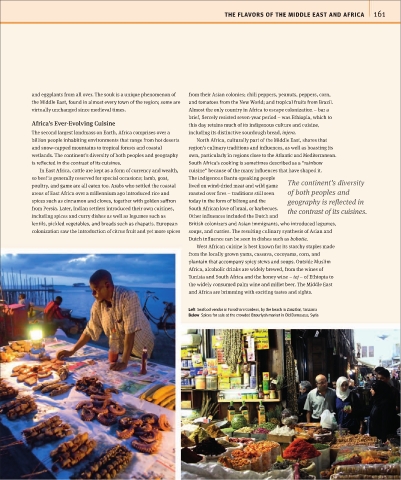
                                                                    Left  Seafood vendor in Forodhani Gardens, by the beach in Zanzibar, Tanzania
                                                                    Below  Spices for sale at the crowded Bzouriyah market in Old Damascus, Syria

