


Page 198 - DK Eyewitness Travel - Guides Ultimate Food Journeys
P. 198
196     ASIA AND AUSTRALASIA


                                                                                         KYOTO


            KYOTO JAPAN

            Fine Dining in Kyoto


            The imperial capital for half a millennium until 1869, Kyoto is the cradle of Japanese culture and
            its historical and spiritual heart. Geishas wander its cherry-tree-lined streets and lanterns are
            lit at night, when the appetizing smell of cooking fills the air. The pinnacle of Kyoto’s culinary
            heritage – the highly refined, multi-course kaiseki – lives on in the city’s historic ryotei restaurants.


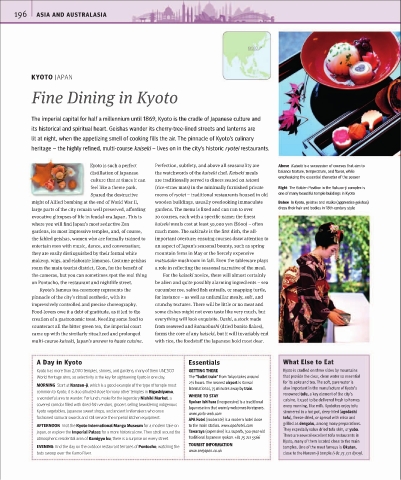
                                 Kyoto is such a perfect   Perfection, subtlety, and above all seasonality are    Above  Kaiseki is a succession of courses that aim to
                                 distillation of Japanese   the watchwords of the kaiseki chef. Kaiseki meals   balance texture, temperature, and flavor, while
                                                                                                    emphasizing the essential character of the season
                                 culture that at times it can   are traditionally served to diners seated on tatami
                                 feel like a theme park.   (rice-straw mats) in the minimally furnished private   Right  The Golden Pavilion in the Rukuon-ji complex is
                                 Spared the destructive   rooms of ryotei – traditional restaurants housed in old   one of many beautiful temple buildings in Kyoto
            might of Allied bombing at the end of World War II,   wooden buildings, usually overlooking immaculate   Below  In Kyoto, geishas and maiko (apprentice geishas)
            large parts of the city remain well preserved, affording   gardens. The menu is fixed and can run to over   dress their hair and bodies in 18th-century style
            evocative glimpses of life in feudal-era Japan. This is   20 courses, each with a specific name; the finest
            where you will find Japan’s most seductive Zen   kaiseki meals cost at least 50,000 yen ($600) – often
            gardens, its most impressive temples, and, of course,   much more. The sakizuke is the first dish, the all-
            the fabled geishas, women who are formally trained to   important overture; ensuing courses draw attention to
            entertain men with music, dance, and conversation;   an aspect of Japan’s seasonal bounty, such as spring
            they are easily distinguished by their formal white   mountain ferns in May or the fiercely expensive
            makeup, wigs, and elaborate kimonos. Costume geishas   matsutake mushroom in fall. Even the tableware plays
            roam the main tourist district, Gion, for the benefit of   a role in reflecting the seasonal narrative of the meal.
            the cameras, but you can sometimes spot the real thing   For the kaiseki novice, there will almost certainly
            on Pontocho, the restaurant and nightlife street.  be alien and quite possibly alarming ingredients – sea
               Kyoto’s famous tea ceremony represents the   cucumber roe, salted fish entrails, or snapping turtle,
            pinnacle of the city’s ritual aesthetic, with its   for instance – as well as unfamiliar mealy, soft, and
            impressively controlled and precise choreography.   crunchy textures. There will be little or no meat and
            Food-lovers owe it a debt of gratitude, as it led to the   some dishes might not even taste like very much, but
            creation of a gastronomic treat. Needing some food to   everything will look exquisite. Dashi, a stock made
            counteract all the bitter green tea, the imperial court   from seaweed and katsuobushi (dried bonito flakes),
            came up with the similarly ritualized and prolonged   forms the core of any kaiseki, but it will invariably end
            multi-course kaiseki, Japan’s answer to haute cuisine.  with rice, the foodstuff the Japanese hold most dear.


              A Day in Kyoto                                        Essentials                        What Else to Eat
              Kyoto has more than 2,000 temples, shrines, and gardens, many of them UNESCO   GETTING THERE  Kyoto is cradled on three sides by mountains
              World Heritage sites, so selectivity is the key for sightseeing Kyoto in one day.   The “bullet train” from Tokyo takes around   that provide the clear, clean water so essential
                                                                    2½ hours. The nearest airport is Kansai   for its sake and tea. The soft, pure water is
              MORNING  Start at Nanzen-ji, which is a good example of the type of temple most
                                                                    International, 75 minutes away by train.   also important in the manufacture of Kyoto’s
              common to Kyoto; it is also situated close to many other temples in Higashiyama,
                                                                    WHERE TO STAY                     renowned tofu, a key element of the city’s
              a wonderful area to wander. For lunch, make for the legendary Nishiki Market, a         cuisine. It used to be delivered fresh to homes
                                                                    Ryokan Ishihara (inexpensive) is a traditional
              covered corridor filled with dried-fish vendors, grocers selling bewildering indigenous   every morning, like milk. Kyotoites enjoy tofu
                                                                    Japanese inn that warmly welcomes foreigners.
              Kyoto vegetables, Japanese sweet shops, and ancient knifemakers who once                simmered in a hot pot, deep-fried (agedashi
                                                                    www.yado-web.com
              fashioned samurai swords and still service the imperial kitchen equipment.              tofu), freeze-dried, or spread with miso and
                                                                    APA Hotel (moderate) is a modern hotel close
                                                                                                      grilled as dengaku, among many preparations.
              AFTERNOON  Visit the Kyoto International Manga Museum for a modern take on   to the main station. www.apahotel.com
                                                                                                      They especially value dried tofu skin, or yuba.
              Japan, or explore the Imperial Palace for a more historical one. Then stroll around the   Tawaraya (expensive) is a superb, 300-year-old   There are several excellent tofu restaurants in
              atmospheric residential area of Kamigyo ku; there is a surprise on every street.  traditional Japanese ryokan. +81 75 211 5566
                                                                                                      Kyoto, many of them located close to the main
                                                                    TOURIST INFORMATION
              EVENING  End the day on the outdoor restaurant terraces of Pontocho, watching the       temples. One of the most famous is Okutan,
                                                                    www.seejapan.co.uk
              bats swoop over the Kamo River.                                                         close to the Nanzen-ji temple (+81 75 771 8709).

