


Page 199 - DK Eyewitness Travel - Guides Ultimate Food Journeys
P. 199
KYOTO JAPAN 197
The Best Places to
Eat Kaiseki
Kikunoi expensive
Kyoto’s finest kaiseki restaurants can be rather
daunting, impenetrable places – some shun diners
they don’t know – but there are a few that
welcome kaiseki novices, offering proper seats
instead of a tatami mat and explaining the courses
to their guests. Of these, the most renowned is
Kikunoi (“chrysanthemum well”), awarded three
Michelin stars in 2011. It was founded in 1912 and is
run by the third-generation chef Yoshihiro Murata in
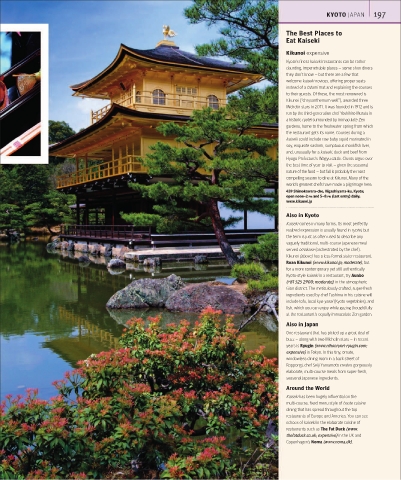
a historic ryotei surrounded by immaculate Zen
gardens, home to the freshwater spring from which
the restaurant gets its name. Courses during a
kaiseki could include raw baby squid marinated in
soy, exquisite sashimi, sumptuous monkfish liver,
and, unusually for a kaiseki, duck and beef from
Hyogo Prefecture’s Wagyu cattle. Clients argue over
the best time of year to visit – given the seasonal
nature of the food – but fall is probably the most
compelling season to dine at Kikunoi. Many of the
world’s greatest chefs have made a pilgrimage here.
459 Shimokawara-cho, Higashiyama-ku, Kyoto;
open noon–2 PM and 5–8 PM (last entry) daily;
www.kikunoi.jp
Also in Kyoto
Kaiseki comes in many forms. Its most perfectly
realized expression is usually found in ryotei, but
the term is just as often used to describe any
vaguely traditional, multi-course Japanese meal
served omakase (orchestrated by the chef).
Kikunoi (above) has a less formal sister restaurant,
Roan Kikunoi (www.kikunoi.jp; moderate), but
for a more contemporary yet still authentically
Kyoto-style kaiseki in a restaurant, try Aunbo
(+81 525 2900; moderate), in the atmospheric
Gion district. The meticulously crafted, super-fresh
ingredients used by chef Tashima in his cuisine will
include tofu, local kyo-yasai (Kyoto vegetables), and
fish, which you can enjoy while gazing thoughtfully
at the restaurant’s equally immaculate Zen garden.
Also in Japan
One restaurant that has picked up a great deal of
buzz – along with two Michelin stars – in recent
years is Ryugin (www.nihonryori-ryugin.com;
expensive) in Tokyo. In this tiny, ornate,
windowless dining room in a back street of
Roppongi, chef Seiji Yamamoto creates gorgeously
elaborate, multi-course meals from super-fresh,
seasonal Japanese ingredients.
Around the World
Kaiseki has been hugely influential on the
multi-course, fixed menu style of haute cuisine
dining that has spread throughout the top
restaurants of Europe and America. You can see
echoes of kaiseki in the elaborate cuisine of
restaurants such as The Fat Duck (www.
thefatduck.co.uk; expensive) in the UK and
Copenhagen’s Noma (www.noma.dk).

