


Page 229 - DK Eyewitness Travel - Guides Ultimate Food Journeys
P. 229
SEOUL SOUTH KOREA       227


                                                                                                       The Best Places for
                                                                                                       Korean Royal Cuisine
                                                                                        SEOUL
                                                                                                       Goongyeon expensive
                                                                                                       This deceptively homey restaurant is
                                                                                                       Korea’s only remaining link to the royal court
                                                                                                       cuisine of old. Its founder, Hwang Hye-seong,
            SEOUL SOUTH KOREA
                                                                                                       learned her trade from one of the last royal
                                                                                                       chefs of the Joseon dynasty, absorbing the
            A Royal Banquet in Seoul                                                                   ancient secrets over the course of several
                                                                                                       decades. These have now been passed on to
                                                                                                       her daughter Han Bong-nyeo; like her illustrious
                                                                                                       mother, Han has been designated an official
            In the sparkling Korean capital of Seoul, it really is possible to eat like a king – the banquets   national treasure. After taking your seat, you’ll
                                                                                                       soon find the table blanketed with dishes,
            served here replicate those held for the kings of the Joseon dynasty, who ruled from the 14th to
                                                                                                       almost creaking under the weight of more than
            the early 20th century. These royal banquets have tables groaning under innumerable exquisite   30 individually prepared creations. You’ll literally
                                                                                                       be eating like a king in almost every sense,
            dishes, whose myriad tastes and colors nonetheless blend into a gentle Eastern harmony.
                                                                                                       since both the way in which the meal is laid
                                                                                                       out and the ingredients in the dishes are as
                             Bustling with commerce,    fiery-red elements such as spicy gimchi or kimchee   close as possible to what Joseon royalty would
                             drenched with neon, and pierced    (preserved vegetables) are counterbalanced by bland   have been presented with each evening.
                                                                                                       Celadon bowls, bronze chopsticks, and
                             by innumerable skyscrapers,   soups and delicately seasoned roots.
                                                                                                       lacquered wooden trays heighten the air of
                             Seoul is one of the world’s most   Traditionally, banquets are made up of 12 main
                                                                                                       authenticity, while floor-to-ceiling windows offer
            absorbingly modern cities. However, it is also a place   dishes, augmented by smaller side dishes known as
                                                                                                       views of the pine-studded garden outside.
            of substantial historical merit, having served as the   banchan. Ingredients are always the finest the season
                                                                                                       170–3 Gaheodong, Seoul; open noon–3 PM &
            seat of the Joseon dynasty from 1392 until its annexation   can offer, culled from both land and sea. The variety    5:30–9 PM; www.goongyeon.com
            by Japan in 1910. Joseon’s first king, Taejo, was evidently   is quite incredible, with offerings as diverse as
            hugely ambitious – the first few years of his rule saw the   buckwheat noodles, pumpkin congee, mung-bean   Also in Seoul
            birth of two mighty palaces, a huge ancestral shrine, and   pancakes, and pheasant-meat dumplings. Many of   Set within a clutch of traditional wooden
            a city wall studded with gargantuan gates. Amazingly,   these dishes can be found in Korean home cooking,    buildings on Pildong Iga, Korea House
            despite the passing of half a millennium, the Japanese   but two of the most visually arresting are unique to   (www.koreahouse.or.kr; expensive) serves up
                                                                                                       mammoth royal banquets – not quite scaling
            occupation, and the devastating civil war of the 1950s,   royal cuisine. The sinsollo is a bronze urn used at the
                                                                                                       the heights of the cuisine in Goongyeon, but
            all of these sites remain, with superb restoration work   table to make a richly aromatic meatball-and-vegetable
                                                                                                       first-time visitors will scarcely be able to tell the
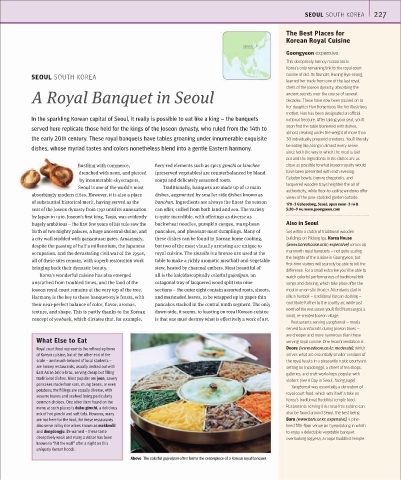
            bringing back their dynastic beauty.        stew, heated by charcoal embers. Most beautiful of
                                                                                                       difference. For a small extra fee you’ll be able to
               Korea’s wonderful cuisine has also emerged    all is the kaleidoscopically colorful gujeolpan, an   watch colorful performances of traditional folk
            unscathed from troubled times, and the food of the   octagonal tray of lacquered wood split into nine   songs and dancing, which take place after the
            Joseon royal court remains at the very top of the tree.   sections – the outer eight contain assorted roots, shoots,   meal in an on-site theater. Attendants clad in
            Harmony is the key to these banquet-style feasts, with   and marinaded leaves, to be wrapped up in paper-thin   silken hanbok – traditional Korean clothing –
            their near-perfect balance of color, flavor, aromas,   pancakes stacked in the central ninth segment. The only   contribute further to the courtly air, while just
                                                                                                       north of the restaurant you’ll find Namsangol, a
            texture, and shape. This is partly thanks to the Korean   down-side, it seems, to feasting on royal Korean cuisine
                                                                                                       small, re-created Joseon village.
            concept of yeobaek, which dictates that, for example,   is that one must destroy what is effectively a work of art.
                                                                                                         Restaurants serving yangbansik – meals
                                                                                                       served to aristocrats during Joseon times –
                                                                                                       are cheaper and more numerous than those
              What Else to Eat                                                                         serving royal cuisine. One recommendation is
              Royal court food represents the refined epitome                                           Doore (www.edoore.co.kr; moderate), which
              of Korean cuisine, but at the other end of the                                           serves what are essentially smaller versions of
              scale – and much-beloved of local students –                                             the royal feasts in a pleasantly rustic courtyard
              are homey restaurants, usually decked out with                                           setting on Insadonggil, a street of tea shops,
              East Asian bric-a-brac, serving cheap but filling                                         galleries, and craft workshops popular with
              traditional dishes. Most popular are jeon, savory
                                                                                                       visitors (see A Day in Seoul, facing page).
              pancakes made from corn, mung beans, or even                                               Yangbansik was essentially a derivation of
              potatoes; the fillings are equally diverse, with
                                                                                                       royal court food, which was itself a take on
              sesame leaves and seafood being particularly
              common choices. One other item found on the                                              Korea’s traditional Buddhist temple food.
              menu at such places is dubu-gimchi, a delicious                                          Restaurants serving this meat-free cuisine can
              mix of hot gimchi and soft tofu. However, many                                           also be found around Seoul, the best being
              are not here for the food, for these restaurants                                         Baru (www.baru.or.kr; expensive), a pine-
              also serve milky rice wines known as makkeolli                                           lined fifth-floor venue on Gyeonjidong in which
              and dongdongju. Be warned – these taste                                                  to enjoy a delectable vegetable banquet
              deceptively weak and many a visitor has been                                             overlooking Jogyesa, a major Buddhist temple.
              known to “hit the wall” after a night on this
              uniquely Korean hooch.

                                                Above  The colorful gujeolpan often forms the centerpiece of a Korean royal banquet

