


Page 302 - DK Eyewitness Travel - Guides Ultimate Food Journeys
P. 302
300     SOUTH AMERICA


                        The Flavors of


                        South America


                        Few continents have been blessed with as varied a culinary heritage as South America, and this heritage is gaining wider

                        international acclaim as more travelers start exploring the many different aspects of these nations. Rich stews and soups
                        dominate the cooler mountain regions, while the long coastlines offer up fresh fish cured and cooked in unusual ways.
                        Simply delicious beef is on the menu almost everywhere, but nowhere better than from the pampas of Argentina.


                        The indigenous peoples of South America, the conquering   and Medellín’s Otro Sabor, also attract visitors from near and far.
                        Spaniards and Portuguese, and a large influx of African slaves have   What’s influenced South American cuisine more than any other
                        all contributed their distinct cooking traditions and ingredients to   feature is also what has inspired many a traveler – its wonderful
                        the culinary mix in the continent. And as if these weren’t enough,   variety of landscapes: desolate high plateaus, deeply cut ravines,
                        Chinese, Japanese, Jewish, Indian, Lebanese, German, French,   snow-capped cordilleras (mountain ranges), endless rolling
                        Italian, and British gastronomical influences have followed in their   pasturelands, and the sheer immensity of the Amazon basin.
                        wake, making South America a true foodie melting pot.
                          Many of the most popular foods enjoyed worldwide – potatoes,   Coast-to-Coast Cuisines
                        chili and sweet peppers, peanuts, corn, and the one with the   In South America, food is often regional, rather than national, in
                                               highest “yummy factor” of all:   character: warming stews and soups in the Andean region, good
               The gastronomical centers
                                               chocolate – hail from South America.   fish and seafood along the lengthy coastlines and mighty rivers,
              of Lima, Buenos Aires, and       In an unofficial exchange, Europeans   and superb beef in the cattle and farming areas. Peru’s famous
                Rio de Janeiro now boast       introduced chicken, pork, beef (along   ceviche (lime-cured seafood with salt and perhaps a sprinkling of
                                               with dairy products), wheat, sugar,   chili pepper) is popular along many parts of the Pacific and
                 world-class restaurants.
                                               citrus trees, onions, and garlic, as   Caribbean coasts. In Colombia and Venezuela, as well as northern
                        well as certain herbs and spices such as oregano, parsley, and
                        cloves, to South America, and also passed on their winemaking
                        techniques, all of which changed the food culture forever.
                          Today’s cuisine has come a long way from its humble
                        beginnings of often corn-based dishes, and the gastronomical
                        centers of Lima, Buenos Aires, and Rio de Janeiro now boast
                        world-class restaurants. Food festivals, such as Lima’s Mistura


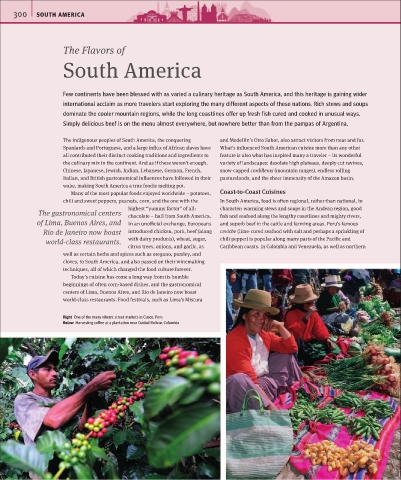
                        Right  One of the many vibrant street markets in Cusco, Peru
                        Below  Harvesting coffee at a plantation near Cuidad Bolívar, Colombia

