


Page 306 - DK Eyewitness Travel - Guides Ultimate Food Journeys
P. 306
304     SOUTH AMERICA


                                                                                      QUITO


            QUITO ECUADOR

            Hearty Soup High in the Andes


            Beneath towering snow-capped mountains, the highland Ecuadorians, living at some 10,000 ft
            (3,000 m) above sea level, have long cherished the restorative powers of their native crop, the
            potato. Amid the lower fertile valleys, herds of grazing cows provide fresh cheese and milk for
            the rich, creamy dish locro de papa, guaranteed to get you up and over the next hilltop.


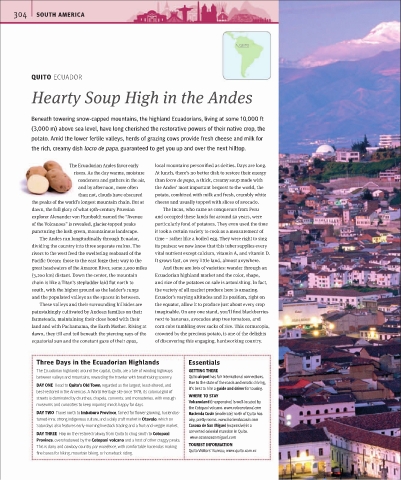
                          The Ecuadorian Andes favor early   local mountains personified as deities. Days are long.
                           risers. As the day warms, moisture   At lunch, there’s no better dish to restore their energy
                             condenses and gathers in the air,   than locro de papa, a thick, creamy soup made with
                             and by afternoon, more often   the Andes’ most important bequest to the world, the
                             than not, clouds have obscured   potato, combined with milk and fresh, crumbly white
            the peaks of the world’s longest mountain chain. But at   cheese and usually topped with slices of avocado.
            dawn, the full glory of what 19th-century Prussian   The Incas, who came as conquerors from Peru
            explorer Alexander von Humboldt named the “Avenue   and occupied these lands for around 50 years, were
            of the Volcanoes” is revealed, glacier-topped peaks   particularly fond of potatoes. They even used the time
            puncturing the lush green, mountainous landscape.   it took a certain variety to cook as a measurement of
               The Andes run longitudinally through Ecuador,   time – rather like a boiled egg. They were right to sing
            dividing the country into three separate realms. The   its praises: we now know that this tuber supplies every
            rivers to the west feed the sweltering seaboard of the   vital nutrient except calcium, vitamin A, and vitamin D.
            Pacific Ocean; those to the east forge their way to the   It grows fast, on very little land, almost anywhere.
            great headwaters of the Amazon River, some 2,000 miles   And there are lots of varieties: wander through an
            (3,200 km) distant. Down the center, the mountain   Ecuadorian highland market and the color, shape,
            chain is like a Titan’s stepladder laid flat north to   and size of the potatoes on sale is astonishing. In fact,
            south, with the higher ground as the ladder’s rungs   the variety of all market produce here is amazing.
            and the populated valleys as the spaces in between.  Ecuador’s varying altitudes and its position, right on
               These valleys and their surrounding hillsides are   the equator, allow it to produce just about every crop
            painstakingly cultivated by Andean families on their   imaginable. On any one stand, you’ll find blackberries
            farmsteads, maintaining their close bond with their   next to bananas, avocados atop tree tomatoes, and
            land and with Pachamama, the Earth Mother. Rising at   corn cobs tumbling over sacks of rice. This cornucopia,
            dawn, they till and toil beneath the piercing rays of the   crowned by the precious potato, is one of the delights
            equatorial sun and the constant gaze of their apus,   of discovering this engaging, hardworking country.


              Three Days in the Ecuadorian Highlands                Essentials
              The Ecuadorian highlands around the capital, Quito, are a tale of winding highways   GETTING THERE
              between valleys and mountains, rewarding the traveler with breathtaking scenery.   Quito airport has fair international connections.
                                                                    Due to the state of the roads and erratic driving,
              DAY ONE  Head to Quito’s Old Town, regarded as the largest, least-altered, and
                                                                    it’s best to hire a guide and driver for touring.
              best-restored in the Americas. A World Heritage site since 1978, its colonial grid of
                                                                    WHERE TO STAY
              streets is dominated by churches, chapels, convents, and monasteries, with enough
                                                                    Volcanoland (inexpensive) is well-located by
              museums and curiosities to keep inquiring minds happy for days.
                                                                    the Cotopaxi volcano. www.volcanoland.com
              DAY TWO  Travel north to Imbabura Province, famed for flower-growing, haciendas-  Hacienda Cusín (moderate) north of Quito has
              turned-inns, strong indigenous culture, and a daily craft market in Otavalo, which on   airy, pretty rooms. www.haciendacusin.com
              Saturdays also features early-morning livestock trading and a fruit-and-veggie market.   Casona de San Miguel (expensive) is a
                                                                    converted colonial mansion in Quito.
              DAY THREE  Hop on the restored railway from Quito to chug south to Cotopaxi
                                                                     www.casonasanmiguel.com
              Province, overshadowed by the Cotopaxi volcano and a host of other craggy peaks.
                                                                    TOURIST INFORMATION
              This is dairy and cowboy country par excellence, with comfortable haciendas making
                                                                    Quito Visitors’ Bureau; www.quito.com.ec
              fine bases for hiking, mountain biking, or horseback riding.

