


Page 34 - All About History - Issue 58-17
P. 34
Da Vinci: Was he Really a Genius?


        Although the ey were all eventually acquitted, the
           o
           t
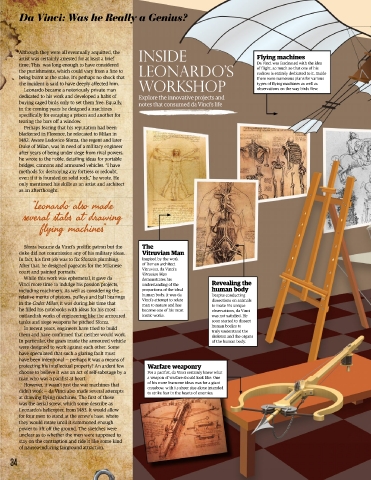
        artist was cer rtainly arrested for at least a brief  Inside                       Flying machines
                was long enough to have considered
        time. This w                                                                       Da Vinci was fascinated with the idea
                                                                                           offlight,somuchsothatoneofhis
           p
        the punishme ents, which could vary from a fine to  Leonardo’s                     codices is entirely dedicated to it. Inside
        being burnt a atthestake.It’sperhapsnoshockthat                                    there were numerous plans for various
           g
        the incident i ssaidtohavedeeplyaffectedhim.  workshop                             types of flying machines as well as
           n
           o
         Leonardo b                                                                        observations on the way birds flew.
                 became a notoriously private man
                 his work and developed a habit of
           c
        dedicated to h                            Explore the innovative projects and
        buying caged                              notes that consumed da Vinci’s life
           n
        buying caged birds only to set them free. Equally,
        in the coming years he designed a machines
        specifically for escaping a prison and another for
        tearing the bars off a window.
         Perhaps fearing that his reputation had been
        blackened in Florence, he relocated to Milan in
        1482. Aware Ludovico Sforza, the regent and later
        DukeofMilan,wasinneedofamilitary engineer
        after years of being under siege from rival powers,
        he wrote to the noble, detailing ideas for portable
        bridges, cannons and armoured vehicles. “I have
        methods for destroying any fortress or redoubt,
        even if it is founded on solid rock,” he wrote. He
        only mentioned his skills as an artist and architect
        as an afterthought.
            “Leonardo also made
         several stabs at drawing
               flying machines”


         Sforza became da Vinci’s prolific patron but the  The
        duke did not commission any of his military ideas.   Vitruvian Man
        In fact, his first job was to fix Sforza’s plumbing.   Inspired by the work
        After that, he designed pageants for the Milanese   of Roman architect
                                                   Vitruvius, da Vinci’s
        court and painted portraits.
                                                   Vitruvian Man
         While this work was ephemeral, it gave da   demonstrates his
        Vinci more time to indulge his passion projects,   understanding of the  Revealing the
        including machinery. As well as considering the   proportions of the ideal  human body
                                                   human body. It was da   Despite conducting
        relative merits of pistons, pulleys and ball bearings
                                                   Vinci’s attempt to relate  dissections on animals
        in the Codex Milan, it was during his time that   man to nature and has  to make his unique
        he filled his notebooks with ideas for his most   become one of his most  observations, da Vinci
        outlandish works of engineering like the armoured   iconic works.  was not satisfied. He
        tanks and siege weapons he pitched Sforza.                         soon started to dissect
                                                                           human bodies to
         In recent years, engineers have tried to build
                                                                           truly u understand the
        them and have confirmed that neither would work.                   skeleto onandtheorgans
        In particular, the gears inside the armoured vehicle               of the human body.
        were designed to work against each other. Some
        have speculated that such a glaring fault must
        have been intentional — perhaps it was a means of
        protecting his intellectual property? An ardent few   Warfare weaponry
        choose to believe it was an act of self-sabotage by a   Forapacifist,daVincicertainlyknewwhat
        man who was a pacifist at heart.             a weapon of warfare should look like. One
                                                     of his more fearsome ideas was for a giant
         However, it wasn’t just the war machines that
                                                     crossbow, with its sheer size alone intended
        didn’t work — da Vinci also made several attempts   to strike fear in the hearts of enemies.
        at drawing flying machines. The first of these
        was the aerial screw, which some describe as
        Leonardo’s helicopter, from 1483. It would allow
        for four men to stand at the screw’s base, where
        they would rotate until it summoned enough
        power to lift off the ground. The sketches were
        unclear as to whether the men were supposed to
        stay on the contraption and ride it like some kind
        of nausea-inducing fairground attraction.


     34

