


Page 349 - (DK Eyewitness) Travel Guide - USA
P. 349
NE W ORLEANS , L OUISIANA 347
New Orleans Jazz
Jazz is America’s original contribution to world culture.
It evolved slowly and almost imperceptibly from a number
of sources – the music played at balls, parades, dances,
and funerals, and New Orleans’ unique blend of cultures.
Its musical inspirations included African work chants and
spirituals, as well as European and American folk
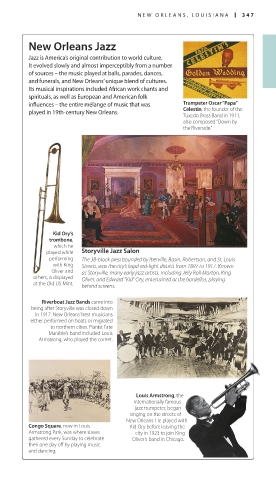
influences – the entire mélange of music that was Trumpeter Oscar “Papa”
played in 19th-century New Orleans. Celestin, the founder of the
Tuxedo Brass Band in 1911,
also composed “Down by
the Riverside.”
Kid Ory’s
trombone,
which he
played while Storyville Jazz Salon
performing The 38-block area bounded by Iberville, Basin, Robertson, and St. Louis
with King Streets, was the city’s legal red-light district from 1897 to 1917. Known
Oliver and as Storyville, many early jazz artists, including Jelly Roll Morton, King
others, is displayed Oliver, and Edward “Kid” Ory, entertained at the bordellos, playing
at the Old US Mint. behind screens.
Riverboat Jazz Bands came into
being after Storyville was closed down
in 1917. New Orleans’ best musicians
either performed on boats or migrated
to northern cities. Pianist Fate
Marable’s band included Louis
Armstrong, who played the cornet.
Louis Armstrong, the
internationally famous
jazz trumpeter, began
singing on the streets of
New Orleans. He played with
Congo Square, now in Louis Kid Ory before leaving the
Armstrong Park, was where slaves city in 1923 to join King
gathered every Sunday to celebrate Oliver’s band in Chicago.
their one day off by playing music
and dancing.
346-347_EW_USA.indd 347 11/2/16 2:45 PM

