


Page 435 - (DK Eyewitness) Travel Guide - USA
P. 435
INTRODUCING THE GREA T PLAINS 433
THE GREAT PLAINS
From an airplane, the Great Plains looks like a repeated pattern of rectangular
fields and arrow-straight highways, prompting urban Americans to dub it
“fly-over country.” This predominantly rural and agricultural region, which
stretches clear across the center of the country, embodies the all-American
ideals of independence and hard-working self-sufficiency.
The Great Plains is deeply rooted, both Visitors can get a better sense of the
literally and figuratively, at the center region’s culture by spending some time
of the American psyche. Though city- in bucolic, smaller towns.
dwellers on both the East and West
coasts may deride the region’s general History
lack of sophistication, its residents’ Throughout the 17th and 18th centuries,
obvious pride in traditional values and French traders and fur trappers explored
old-fashioned lifestyles explain why this the region, coming into contact with
area is still the ideal location for all that the diverse Native American tribes who
is essentially American. lived here. These tribes varied from the
In fiction and film, the region has sedentary, agriculture-based cultures
spawned such all-American creations of the Caddo and Mandan people to the
as Mark Twain’s Huckleberry Finn, Dorothy Pawnee, Osage, and Comanche, whose
in The Wizard of Oz, the pioneer family livelihoods depended on hunting
of Little House on the Prairie, and the migratory herds of bison (or buffalo).
homespun sentimentality of Field of As Europeans settled along the East
Dreams and The Bridges of Madison County. Coast, other tribes relocated westward
Its rural reaches, with their vast expanses to the Great Plains. The most tragic mass
of fertile farmlands, form the basis of the migration to this region took place in
Great Plains identity. Larger cities, such as 1838, when the Cherokee Nation was
Tulsa, St. Louis, Kansas City, and Oklahoma forced to relinquish all lands east of the
City, hold the bulk of the population as Mississippi River. In exchange, they were
well as the museums, historic sights, and granted land for “as long as the grass
a wide range of hotels and resturants. grows or the waters run,” in what was then
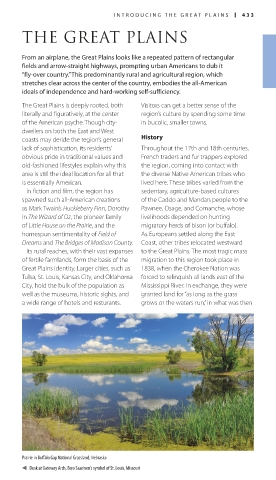
Prairie in Buffalo Gap National Grassland, Nebraska
Dusk at Gateway Arch, Eero Saarinen’s symbol of St. Louis, Missouri
432-435_EW_USA.indd 433 11/2/16 2:46 PM

