


Page 437 - (DK Eyewitness) Travel Guide - USA
P. 437
INTRODUCING THE GREA T PLAINS 435
reservations, while homesteading settlers other weather extremes, such as flood-
took their place. These family-run farms, inducing rains, scorching summer heat
growing wheat, corn, cattle, and pigs, are and humidity, and frigid winter blizzards.
still emblematic of the region, though
many farms are now operated on an People & Culture
industrial scale by absentee landlords. The The Great Plains is, by and large,
high point of agriculture was the World conservative, with patriotism and religion
War I era, when farm prices were high and the dominating cultural values. Yet it
mechanization had yet to replace horse- also is a region of varied cultural and
drawn plows and other labor-intensive political traditions. In the 19th century,
methods. The economic low point came Kansas was one of the prime anti-slavery
soon afterward, when a sudden postwar battlegrounds, but at the turn of the
drop in prices and a decade of drought 21st century the state insisted that
turned the region into the “Dust Bowl,” biblical ideas of creationism be taught in
forcing some 200,000 farmers and their school science classes.
families to move west to California, a Ethnically, however, the population is
saga movingly documented in John surprisingly diverse, and includes the
Steinbeck’s The Grapes of Wrath. Swedish settlement of Lindsborg.
Many of the orig inal immigrants
Geology & Climate were lured here from similar terrain
The land is what defines life in in Europe, notably the steppes of
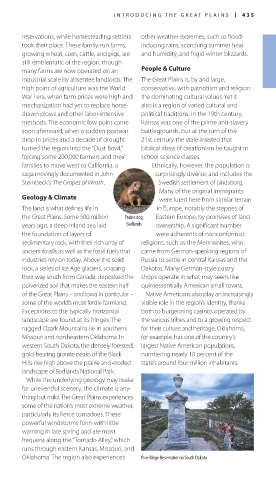
the Great Plains. Some 500 million Prairie dog, Eastern Europe, by promises of land
years ago, a deep inland sea laid Badlands ownership. A significant number
the foundation of layers of were adherents of nonconformist
sedimentary rock, with their rich array of religions, such as the Menno nites, who
ancient fossils as well as the fossil fuels that came from German-speaking regions of
industries rely on today. Above this solid Russia to settle in central Kansas and the
rock, a series of Ice Age glaciers, scraping Dakotas. Many German-style pastry
their way south from Canada, deposited the shops operate in what may seem like
pulverized soil that makes the eastern half quintessentially American small towns.
of the Great Plains – and Iowa in particular – Native Americans also play an increasingly
some of the world’s most fertile farmland. visible role in the region’s identity, thanks
Exceptions to the typically horizontal both to burgeoning casinos operated by
landscape are found at its fringes. The the various tribes and to a growing respect
rugged Ozark Mountains lie in southern for their culture and heritage. Oklahoma,
Missouri and northeastern Oklahoma. In for example, has one of the country’s
western South Dakota, the densely forested, largest Native American populations,
gold-bearing granite peaks of the Black numbering nearly 10 percent of the
Hills rise high above the prairie and eroded state’s around four million inhabitants.
landscape of Badlands National Park.
While the underlying geology may make
for uneventful scenery, the climate is any-
thing but mild. The Great Plains experiences
some of the nation’s most extreme weather,
particularly its fierce tornadoes. These
powerful windstorms form with little
warning in late spring and are most
frequent along the “Tornado Alley,” which
runs through eastern Kansas, Missouri, and
Oklahoma. The region also experiences Pine Ridge Reservation in South Dakota
432-435_EW_USA.indd 435 11/2/16 2:46 PM

