


Page 232 - Easy Japanese - Learn to Speak Japanese Quickly! (TUTTLE)
P. 232
The  sentences  on  the  right  above  can  be  changed  to  the  informal  style  by
               switching omoimasu to omou. Note that by expressing your thought in the form
               of  a  question,  you  can  soften  its  impact  and  show  politeness  when  you  are
               disagreeing.
                    Chotto muzukashi’i ka to             I wonder if it might be a bit
                    omoimasu.                            difficult.

                    Fuben ja nai ka to omu               I wonder if it isn’t
                    kedo…                                inconvenient, and…


                   GRAMMAR NOTE Onomatopoeia

               Dokidoki is an example of Japanese onomatopoeia (オノマトペ), like the sound
               your heartbeat makes. Onomatopoeia is abundant in Japanese, as you can see on
               the pages of comic books. The list on the next page are the most common.

                   Many  Japanese  onomatopoeias  consist  of  four  syllables  with  the  first  two
               syllables  repeated  twice,  like  dokidoki,  and  you  find  them  written  in  either
               hiragana or katakana. Usually shimasu or desu follow them.
                    Dokidoki shimasu.                    I’m nervous/thrilled.

                    Dokidoki deshita.                    I was nervous/thrilled.


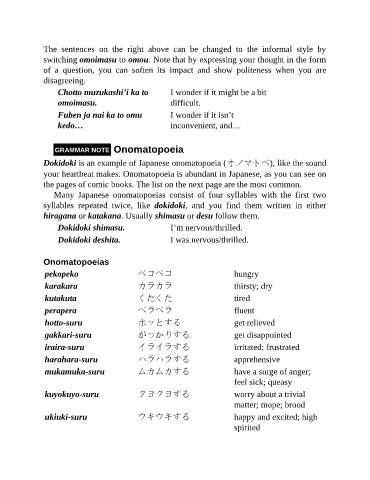
               Onomatopoeias

                pekopeko                       ペコペコ                           hungry
                karakara                       カラカラ                           thirsty; dry

                kutakuta                       くたくた                           tired
                perapera                       ペラペラ                           fluent

                hotto-suru                     ホッとする                          get relieved
                gakkari-suru                   がっかりする                         get disappointed

                iraira-suru                    イライラする                         irritated; frustrated

                harahara-suru                  ハラハラする                         apprehensive
                mukamuka-suru                  ムカムカする                         have a surge of anger;
                                                                              feel sick; queasy

                kuyokuyo-suru                  クヨクヨする                         worry about a trivial
                                                                              matter; mope; brood
                ukiuki-suru                    ウキウキする                         happy and excited; high

                                                                              spirited

