


Page 23 - All About History - Issue 38-16
P. 23
Dictators


                                                                                           CUT THE STENCILS

                                                                                           For the windows, up to 65 stencils would be cut to
                                                                                           make up the individual elements. Unlike printed
                                                                                           posters, windows could vary in size and intricacy
                                                                                           as they were pieced together from multiple sheets
                                                                                           of paper and put up in shop windows. There was
                                                                                           also no restriction on the number of colours used.
                                                                                           THE POSTER HITS THE

                                                                                           PRODUCTION LINE

                                                                                           An assembly line of workers would then spring
                                                                                           into action: the stencil was put in place, one painter
                                                                                           gave it a splash of colour, another stencil came
                                                                                           down, another painter added his or her paints, text
                                                                                           cutters added their stencils and so on, as the pages
                                                                                           were passed from workstation to workstation.

                                                                                           THE WORKER ANTS DO

                                                                                           THEIR THING

                                                                                           With one eye on the clock, three shifts of workers
                                                                                           would turn out between 50 and 1,500 copies of
                                                                                           each poster a day. Each one would have been
                                                                                           produced by hand. This was actually quicker than
                                                                                           lithographic printing, because if there’s one thing
                                                                                           the Soviet Union wasn’t shy of, it was manpower.
                                                                                           THE BIG REVEAL


                                                                                           Between 12 and 20 individual sheets of paper
                                                                                           would be stuck together, revealing a single
                                                                                           gargantuan image that could be as big as 12 foot
                                                                                           tall. The finished product was a masterpiece –
                                                                                           painted by hand, it had greater detail than would
                                                                                           be possible in a printed poster.

                                                                                           PRINTS CHARMING

                                                                                           A run of postcard-sized flyers and lithographs
                                                                                           would be printed using the same design. They had
                                                                                           flatter colours and less texture, but were far easier
                                                                                           to transport across the country to the far-flung
                                                                                           reaches of the red empire. Some designs were later
                                                                                           outsourced to studios like Gopolitizdat, Sotrudnik
                                                                                           and Iskusstvo to print en masse.
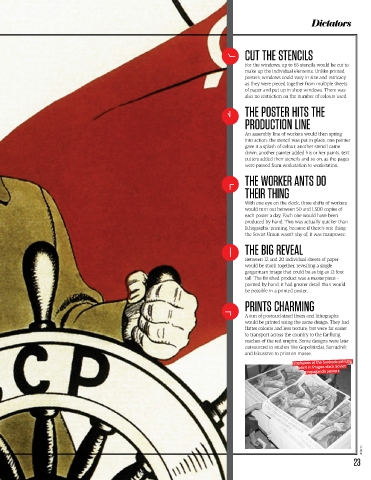
                                                                                                            Employees at the Svoboda printing
                                                                                                              plant in Prague stack Soviet
                                                                                                                 propaganda posters


                                                                                                                                    © Alamy

                                                                                                                                  23


       022-023_AAH033_DayintheLife.indd   23                                                                                 13/04/2016   22:41

