


Page 19 - All About History - Issue 38-16
P. 19
Dictators


             Generators                              End of the Führerbunker
             The bunker was powered by a             The Soviets blew up the area in the late 1940s,    Reinforced concrete
             series of engines that had been         destroying part of the bunker. Just over four      The thick bunker walls were made
             installed once it was realised that     decades later in 1988, the German Democratic       of concrete and each door was made
             Hitler was planning on long-term        Republic (GDR) decided to demolish it further,     air tight to protect from potential gas
             occupation. Housed in one room,         blocking off its entrances in the process. Parts   attacks. This made it bomb proof, but
             the diesel generators provided          of the complex remain underground and              despite being so well protected, the
             electricity for the entire complex      there is talk of a reconstruction of the bunker    Führerbunker’s weak point was its
             as well as ventilation and water-       opening to the public in the future.               communication system. The small
             extraction pumps. The whole                                                                telephone switchboard meant the
             system was very loud and it is                                                             only way of contacting the outside
             believed that this noise prevented                                                         world were calls to civilians that were
             anyone from hearing the gunshot                                                            used to find out if the Red Army had
             that Hitler fired into his temple.
                                                                                                        advanced to their sector yet.


                                                                                             The Vorbunker
                                                                                             As well as the main Führerbunker, there was another
                                             Subterranean tunnels                            area of the compound known as the Vorbunker. It had
                                             The Vorbunker was connected to the              12 rooms compared to the Führerbunker’s 20 and was
                                             Führerbunker by a tunnel. This allowed          located 6.4 metres underground. It was designed to house
                                             easy access between the two areas of the        sanitary, administrative and auxiliary staff for the smooth
                                             underground complex. The entire bunker was      running of the entire complex, even when Nazi Germany
                                             915 square metres in size and the main entrance   was coming ever closer to complete capitulation.
                                             was a red-carpeted corridor lined with paintings.


                                                  A little bit of luxury
                                                  The entire underground building was
                                                  originally designed as a simple air-
                                                  raid shelter but it became something
                                                  much grander. The luxury of the
             A variety of rooms                   Führerbunker may have been above
             Hitler stayed in the bunker for 105 days from   a standard air-raid bunker but it was
             January 1945 until his suicide in April. The area   a world away from the Wolfsschanze
             was kitted out with a number of quarters to make   (Wolf’s Lair) where Hitler orchestrated
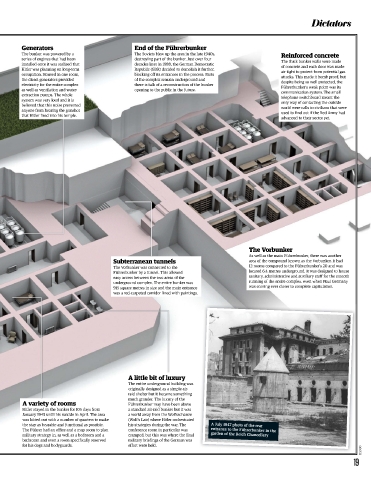
             the stay as bearable and functional as possible.   his strategies during the war. The   A July 1947 photo of the rear
             The Führer had an office and a map room to plan   conference room in particular was   entrance to the Führerbunker in the
             military strategy in, as well as a bedroom and a   cramped, but this was where the final   garden of the Reich Chancellery
             bathroom and even a room specifically reserved   military briefings of the German war
             for his dogs and bodyguards.         effort were held.
                                                                                                                                    © Sol 90

                                                                                                                                  19


       018-019_AAH38_InsideHistory.indd   19                                                                                 13/04/2016   23:01

