


Page 41 - All About History - Issue 38-16
P. 41
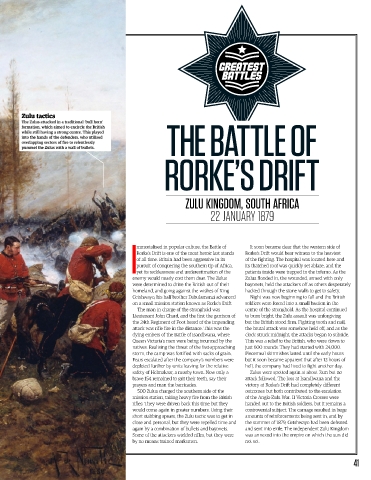
Zulu tactics
             The Zulus attacked in a traditional ‘bull horn’
             formation, which aimed to encircle the British
             while still having a strong centre. This played
             into the hands of the defenders, who utilised      THE BATTLE OF
             overlapping sectors of fire to relentlessly
             pummel the Zulus with a wall of bullets.
                                                               RORKE’S DRIFT


                                                                      ZULU KINGDOM, SOUTH AFRICA

                                                                               22 JANUARY 1879


                                                     mmortalised in popular culture, the Battle of   It soon became clear that the western side of
                                                     Rorke’s Drift is one of the most heroic last stands   Rorke’s Drift would bear witness to the heaviest
                                                     of all time. Britain had been aggressive in its   of the fighting. The hospital was located here and
                                                     pursuit of conquering the southern tip of Africa,   its thatched roof was quickly set ablaze, and the
                                                   I yet its recklessness and underestimation of the   patients inside were trapped in the inferno. As the
                                                    enemy would nearly cost them dear. The Zulus   Zulus flooded in, the wounded, armed with only
                                                    were determined to drive the British out of their   bayonets, held the attackers off as others desperately
                                                    homeland, and going against the wishes of King   hacked through the stone walls to get to safety.
                                                    Cetshwayo, his half brother Dabulamanzi advanced   Night was now beginning to fall and the British
                                                    on a small mission station known as Rorke’s Drift.   soldiers were forced into a small bastion in the
                                                      The man in charge of the stronghold was   centre of the stronghold. As the hospital continued
                                                    Lieutenant John Chard, and the first the garrison of   to burn bright, the Zulu assault was unforgiving
                                                    the 24th Regiment of Foot heard of the impending   but the British stood firm. Fighting tooth and nail,
                                                    attack was rifle fire in the distance. This was the   the brutal attack was somehow held off, and as the
                                                    dying embers of the Battle of Isandlwana, where   clock struck midnight, the attacks began to subside.
                                                    Queen Victoria’s men were being trounced by the   This was a relief to the British, who were down to
                                                    natives. Realising the threat of the fast-approaching   just 600 rounds. They had started with 24,000.
                                                    storm, the camp was fortified with sacks of grain.   Piecemeal skirmishes lasted until the early hours
                                                    Fears escalated after the company’s numbers were   but it soon became apparent that after 12 hours of
                                                    depleted further by units leaving for the relative   hell, the company had lived to fight another day.
                                                    safety of Helmakaar, a nearby town. Now only a   Zulus were spotted again at about 7am but no
                                                    brave 154 remained to grit their teeth, say their   attack followed. The loss at Isandlwana and the
                                                    prayers and man the barricades.        victory at Rorke’s Drift had completely different
                                                      500 Zulus charged the southern side of the   outcomes but both contributed to the escalation
                                                    mission station, taking heavy fire from the British   of the Anglo-Zulu War. 11 Victoria Crosses were
                                                    rifles. They were driven back this time but they   handed out to the British soldiers, but it remains a
                                                    would come again in greater numbers. Using their   controversial subject. The carnage resulted in huge
                                                    short stabbing spears, the Zulu tactic was to get in   amounts of reinforcements being sent in, and by
                                                    close and personal, but they were repelled time and   the summer of 1879, Cetshwayo had been defeated
                                                    again by a combination of bullets and bayonets.   and sent into exile. The independent Zulu Kingdom
                                                    Some of the attackers wielded rifles, but they were   was annexed into the empire on which the sun did
                                                    by no means trained marksmen.          not set.


                                                                                                                                  41


       040-043_AAH_038_GreatestBattles.indd   41                                                                             13/04/2016   22:26

