


Page 64 - All About History - Issue 38-16
P. 64
Through History
TELEPHONES
Today’s phones aren’t just clever gadgets. Every call we make connects us to
telephony’s rich history of creativity, controversy and life-changing innovation
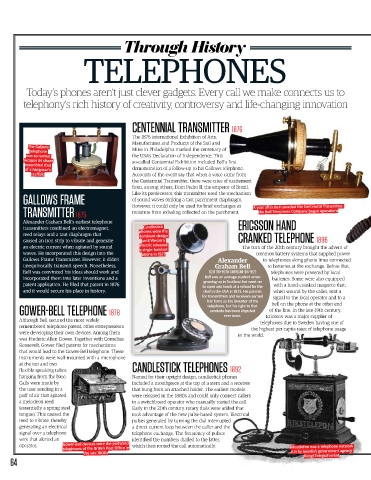
CENTENNIAL TRANSMITTER 1876
The 1876 International Exhibition of Arts,
Manufactures and Products of the Soil and
The Gallows Mine in Philadelphia marked the centenary of
telephone
was so named the USA’s Declaration of Independence. This
because its shape so-called Centennial Exhibition included Bell’s first
resembled that
of a hangman’s demonstration of a follow-up to his Gallows telephone.
scaffold Accounts of the event say that when a voice came from
the Centennial Transmitter, there were cries of excitement
from, among others, Dom Pedro II, the emperor of Brazil.
GALLOWS FRAME Like its predecessor, this transmitter used the mechanism
of sound waves striking a taut parchment diaphragm.
However, it could only be used for brief exchanges as A year after Bell unveiled the Centennial Transmitter,
TRANSMITTER 1875 moisture from exhaling collected on the parchment. the Bell Telephone Company began operations
Alexander Graham Bell’s earliest telephone
transmitters combined an electromagnet, Candlestick ERICSSON HAND
reed relays and a taut diaphragm that phones were the
dominant design
caused an iron strip to vibrate and generate until Western CRANKED TELEPHONE 1896
an electric current when agitated by sound Electric released The turn of the 20th century brought the advent of f
t
0
o
f
h
t
u
n
c
e
n
e
t
h
t
T
e
2
h
u
r
r
ad
e
e
v
t
t
n
h
t
r
o
y
b
h
o
u
g
a single-handset
waves. He incorporated this design into the phone in 1927 common battery systems that supplied power
common battery systems that supplied power
Gallows Frame Transmitter. However, it didn’t Alexander to telephones along phone lines connected
unequivocally transmit speech. Nonetheless, Graham Bell to batteries at the exchange. Before that,
Bell was convinced his ideas should work and SCOTTISH BORN AMERICAN 1847 1922 telephones were powered by local
incorporated them into later inventions and a Bell was an average student when batteries. Some were also equipped
growing up in Scotland but went on
patent application. He filed that patent in 1876 to open and teach at a school for the with a hand-cranked magneto that,
and it would secure his place in history. deaf in the USA in 1872. His patents when wound by the caller, sent a
for transmitters and receivers earned signal to the local operator and to a
him fame as the inventor of the bell on the phone at the other end
telephone, but his right to that
of the line. In the late-19th century,
GOWER BELL TELEPHONE 1878 accolade has been disputed Ericsson was a major supplier of
ever since.
Although Bell secured the most widely telephones due to Sweden having one of
remembered telephone patent, other entrepreneurs the highest per capita rates of telephone usage
were developing their own devices. Among them in the world.
was Frederic Allen Gower. Together with Cornelius
Roosevelt, Gower filed patents for mechanisms
that would lead to the Gower-Bell telephone. These
instruments were wall-mounted with a microphone
at the top and two
flexible speaking tubes CANDLESTICK TELEPHONES 1892
hanging from the base. Named for their upright design, candlestick phones
Calls were made by included a mouthpiece at the top of a stem and a receiver
the user sending in a that hung from an attached holder. The earliest models
puff of air that agitated were released in the 1880s and could only connect callers
a melodeon reed to a switchboard operator who manually routed the call.
(essentially a spring steel Early in the 20th century, rotary dials were added that
tongue). This caused the took advantage of the new pulse-based system. Electrical
reed to vibrate, thereby pulses generated by turning the dial interrupted
generating an electrical a direct current loop between the caller and the
signal over a telephone telephone exchange. The frequency of pulses
wire that alerted an identified the numbers dialled to the latter,
operator. Gower-Bell devices were the preferred which then routed the call automatically. Rikstelefon was a telephone network
telephones of the British Post Office in run by Swedish government agency
the late 1800s Kongl Telegrafverket
64
064-065_AAH_038_ThroughHistory.indd 64 13/04/2016 22:15

