


Page 68 - All About History - Issue 38-16
P. 68
Celts: Cult of Death
DEATH ON THE BATTLEFIELD
With no fear of dying, the Celts were fierce warriors with an unusual habit
sually fighting without armour, defeated, severed heads would be hung by their The Romans had feared the warlike Celts ever
clad in blue woad war paint hair over a horse’s neck and taken to be nailed to since the Sack of Rome in 390 BCE, but this fear
and tattoos, and occasionally the entrance of a fort or sanctuary. The suggested soon changed to a burning desire to see them
completely naked, a Celt was a notion behind this bizarre tradition was that defeated. When Celts were hired as auxiliary
Uforce of nature on the ancient once the head of a vanquished foe was taken, the soldiers in the Roman army, knowledge of their
battlefield. Wielding swords, daggers or javelins Celts believed that the victor would receive the passion for beheading became widespread. Unlike
with a shield, Celtic iron crushed the helmets of spiritual power of the fallen. The heads were later the Romans, who were an efficient and organised
the Roman legionaries as war cries rang out and embalmed and displayed as a sign of victory in fighting force, the Celts were more flamboyant.
musical instruments were blown. After victory, the battle. According to the Celts, the human soul had Stories tell of one Celtic ruler who drove a chariot
Celts set about collecting the heads of both fallen an afterlife, and as it lived in the head, this had to made entirely out of silver into battle. The
comrades and foes as the headhunting began. be kept at all costs. The body, meanwhile, would be obsession with headhunting didn’t end with the
For the Celts, falling on the field of battle wasn’t hung from wooden frames and put on show while Celts, and continued in small pockets of Ireland up
the end. Celtic society had a peculiar obsession enemy weapons were broken up and buried as until the Middle Ages even as Christianity spread
with human heads, and after an enemy was songs of victory filled the air. over the Emerald Isle.
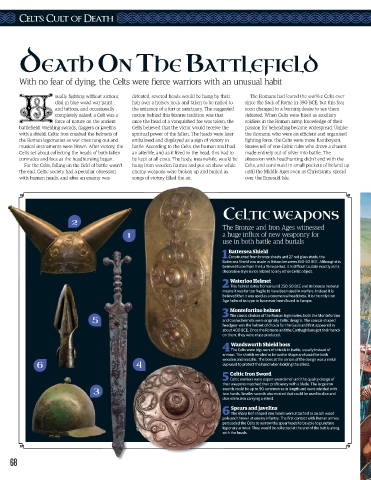
CELTIC WEAPONS
2
The Bronze and Iron Ages witnessed
1 a huge influx of new weaponry for
use in both battle and burials
Battersea Shield
1 Constructed from bronze sheets and 27 red glass studs, the
Battersea Shield was made in Britain between 350 50 BCE. Although it is
believed to be from the La Tène period, it is dicult to date exactly as its
decorative style is not related to any other Celtic object.
Waterloo Helmet
2 This helmet dates from around 250 50 BCE and its bronze material
means it was far too fragile to have been used in warfare. Instead it is
believed that it was used as a ceremonial headdress. It is the only Iron
Age helm of its type to have ever been found in Europe.
Montefortino helmet
5 3 The classic choices of the Roman legionaries, both the Montefortino
and Coolus helmets were originally Celtic designs. The conical-shaped
headgear was the helmet of choice for the Gauls and rst appeared in
about 400 BCE. Once the Romans and the Carthaginians got their hands
on them, they were mass produced.
Wandsworth Shield boss
4 The Celts were big users of shields in battle, usually instead of
armour. The shields tended to be oval in shape and could be both
wooden and metallic. The boss at the centre of the design was a metal
6 4 cup used to protect the hand when holding the shield.
Celtic Iron Sword
5 Celtic warriors were expert swordsmen and the quality design of
their weapons matched their prociency with a blade. The large iron
3 3 swords could be up to 90 centimetres in length and were wielded with
two hands. Smaller swords also existed that could be used to slice and
dice while also carrying a shield.
Spears and javelins
6 The sharp leaf-shaped iron heads were attached to an ash wood
pole and thrown at enemy infantry. The rst contact with Roman armies
persuaded the Celts to narrow the spearheads to be able to puncture
legionary armour. They would be collected at the end of the battle along
with the heads.
68
066-073_AAH38_Celts of Death.indd 68 13/04/2016 22:13

