


Page 54 - Today's Dietitian (February 2020)
P. 54
Focus on Fitness     By Jennifer Van Pelt, MA


                                                                             • NYHA IV: Severe limitations—unable
                                                                              to perform any physical activity with-
                                                                              out discomfort, and symptoms of
                                                                              heart failure even at rest.

                                                                              Patients generally are evaluated with
                                                                            a six-minute walking test and other
                                                                            clinical tests to determine NYHA status,
                                                                            which will determine how they’re man-
                                                                            aged. Despite several medications and
                                                                            device-based treatments for heart fail-
                                                                            ure, between 50% and 75% of those with
                                                                            heart failure will die within five years
                                                                            after diagnosis. 2
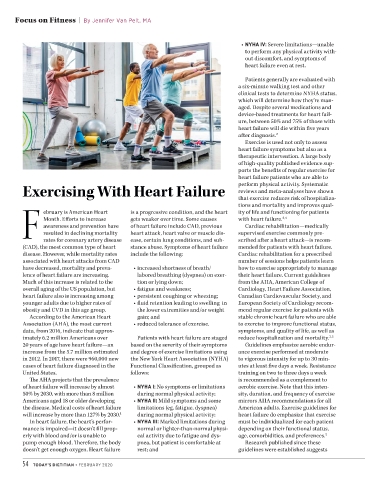
                                                                              Exercise is used not only to assess
                                                                            heart failure symptoms but also as a
                                                                            therapeutic intervention. A large body
                                                                            of high-quality published evidence sup-
                                                                            ports the benefits of regular exercise for
                                                                            heart failure patients who are able to
        Exercising With Heart Failure                                       perform physical activity. Systematic
                                                                            reviews and meta-analyses have shown
                                                                            that exercise reduces risk of hospitaliza-
        F      ebruary is American Heart   is a progressive condition, and the heart   ity of life and functioning for patients
                                                                            tions and mortality and improves qual-
               Month. Efforts to increase
                                          gets weaker over time. Some causes
                                                                            with heart failure.
                                                                                          3,4
               awareness and prevention have
                                                                              Cardiac rehabilitation—medically
                                          of heart failure include CAD, previous
               resulted in declining mortality
                                                                            scribed after a heart attack—is recom-
               rates for coronary artery disease   heart attack, heart valve or muscle dis-  supervised exercise commonly pre-
                                          ease, certain lung conditions, and sub-
        (CAD), the most common type of heart   stance abuse. Symptoms of heart failure   mended for patients with heart failure.
        disease. However, while mortality rates   include the following:    Cardiac rehabilitation for a prescribed
        associated with heart attacks from CAD                              number of sessions helps patients learn
        have decreased, mortality and preva-  • increased shortness of breath/  how to exercise appropriately to manage
        lence of heart failure are increasing.   labored breathing (dyspnea) on exer-  their heart failure. Current guidelines
        Much of this increase is related to the   tion or lying down;       from the AHA, American College of
        overall aging of the US population, but   • fatigue and weakness;   Cardiology, Heart Failure Association,
        heart failure also is increasing among   • persistent coughing or wheezing;  Canadian Cardiovascular Society, and
        younger adults due to higher rates of   • fluid retention leading to swelling  in   European Society of Cardiology recom-
        obesity and CVD in this age group.   the lower extremities and/or weight   mend regular exercise for patients with
          According to the American Heart   gain; and                       stable chronic heart failure who are able
        Association (AHA), the most current   • reduced tolerance of exercise.  to exercise to improve functional status,
        data, from 2016, indicate that approx-                              symptoms, and quality of life, as well as
        imately 6.2 million Americans over   Patients with heart failure are staged   reduce hospitalization and mortality. 3,5
        20 years of age have heart failure—an   based on the severity of their symptoms   Guidelines emphasize aerobic endur-
        increase from the 5.7 million estimated   and degree of exercise limitations using   ance exercise performed at moderate
        in 2012. In 2017, there were 960,000 new   the New York Heart Association (NYHA)   to vigorous intensity for up to 30 min-
        cases of heart failure diagnosed in the   Functional Classification, grouped as   utes at least five days a week. Resistance
        United States.                    follows:                          training on two to three days a week
          The AHA projects that the prevalence                              is recommended as a complement to
        of heart failure will increase by almost   • NYHA I: No symptoms or limitations   aerobic exercise. Note that this inten-
        50% by 2030, with more than 8 million   during normal physical activity;  sity, duration, and frequency of exercise
        Americans aged 18 or older developing   • NYHA II: Mild symptoms and some   mirrors AHA recommendations for all
        the disease. Medical costs of heart failure   limitations (eg, fatigue, dyspnea)   American adults. Exercise guidelines for
        will increase by more than 127% by 2030. 1  during normal physical activity;  heart failure do emphasize that exercise
          In heart failure, the heart’s perfor-  • NYHA III: Marked limitations during   must be individualized for each patient
        mance is impaired—it doesn’t fill prop-  normal or lighter-than-normal physi-  depending on their functional status,
        erly with blood and/or is unable to   cal activity due to fatigue and dys-  age, comorbidities, and preferences. 5
        pump enough blood. Therefore, the body   pnea, but patient is comfortable at   Research published since these
        doesn’t get enough oxygen. Heart failure   rest; and                guidelines were established suggests

        54 TODAY’S DIETITIAN • FEBRUARY 2020

