


Page 286 - (DK) The Ultimate Visual Dictionary 2nd Ed.
P. 286
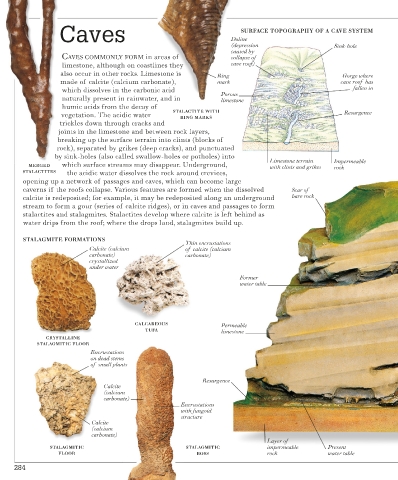
Caves                                           Doline
                                                                    SURFACE TOPOGRAPHY OF A CAVE SYSTEM

                                                                 (depression                  Sink-hole
                                                                 caused by
                  CAVES COMMONLY FORM in areas of                collapse of
                  limestone, although on coastlines they         cave roof)
                  also occur in other rocks. Limestone is    Ring                               Gorge where
                  made of calcite (calcium carbonate),       mark                               cave roof  has
                  which dissolves in the carbonic acid                                             fallen in
                                                              Porous
                  naturally present in rainwater, and in      limestone
                  humic acids from the decay of
                                                 STALACTITE WITH                                 Resurgence
                  vegetation. The acidic water
                                                   RING MARKS
                  trickles down through cracks and
                 joints in the limestone and between rock layers,
                 breaking up the surface terrain into clints (blocks of
                 rock), separated by grikes (deep cracks), and punctuated
                by sink-holes (also called swallow-holes or potholes) into
                                                                            Limestone terrain   Impermeable
         MERGED   which surface streams may disappear. Underground,         with clints and grikes  rock
       STALACTITES  the acidic water dissolves the rock around crevices,
       opening up a network of passages and caves, which can become large
       caverns if the roofs collapse. Various features are formed when the dissolved   Scar of
       calcite is redeposited; for example, it may be redeposited along an underground   bare rock
       stream to form a gour (series of calcite ridges), or in caves and passages to form
       stalactites and stalagmites. Stalactites develop where calcite is left behind as
       water drips from the roof; where the drops land, stalagmites build up.

       STALAGMITE FORMATIONS
                                                    Thin encrustations
                          Calcite (calcium          of  calcite (calcium
                          carbonate)                carbonate)
                          crystallized
                          under water
                                                                    Former
                                                                    water table


                                       CALCAREOUS             Permeable
                                         TUFA                 limestone
              CRYSTALLINE
           STALAGMITIC FLOOR
                          Encrustations
                          on dead stems
                          of  small plants

                                                         Resurgence
                              Calcite
                              (calcium
                              carbonate)
                                                   Encrustations
                                                   with fungoid
                                                   structure
                          Calcite
                          (calcium
                          carbonate)
                                                                           Layer of
               STALAGMITIC                           STALAGMITIC           impermeable      Present
                 FLOOR                                  BOSS               rock             water table

     284

