


Page 376 - (DK) The Ultimate Visual Dictionary 2nd Ed.
P. 376
SEA AND AIR
                                                                                          BOATBUILDERS’
       Viking ships                                                Shave   Broad ax   Breast auger  TOOLS

                                                             Sheer
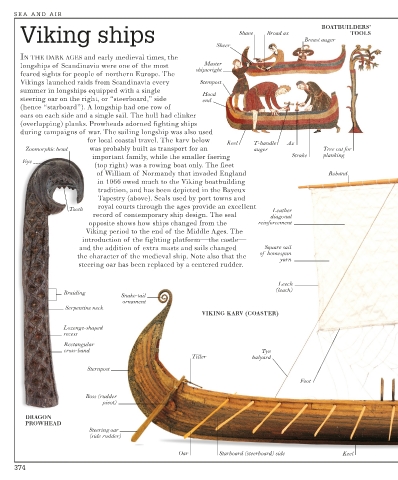
       IN THE DARK AGES and early medieval times, the
       longships of Scandinavia were one of the most      Master
                                                       shipwright
       feared sights for people of northern Europe. The
       Vikings launched raids from Scandinavia every     Stempost
       summer in longships equipped with a single
                                                         Hood
       steering oar on the right, or “steerboard,” side   end
       (hence “starboard”). A longship had one row of
       oars on each side and a single sail. The hull had clinker
       (overlapping) planks. Prowheads adorned fighting ships
       during campaigns of war. The sailing longship was also used
                         for local coastal travel. The karv below   Keel  T-handle    Ax
        Zoomorphic head   was probably built as transport for an       auger               Tree cut for
                           important family, while the smaller faering            Strake   planking
       Eye
                           (top right) was a rowing boat only. The fleet
                            of William of Normandy that invaded England                     Roband
                            in 1066 owed much to the Viking boatbuilding
                            tradition, and has been depicted in the Bayeux
                            Tapestry (above). Seals used by port towns and
                            royal courts through the ages provide an excellent
                    Tooth                                                    Leather
                           record of contemporary ship design. The seal     diagonal
                          opposite shows how ships changed from the      reinforcement
                         Viking period to the end of the Middle Ages. The
                        introduction of the fighting platform—the castle—
                       and the addition of extra masts and sails changed   Square sail
                                                                         of  homespun
                      the character of the medieval ship. Note also that the
                                                                               yarn
                       steering oar has been replaced by a centered rudder.
                                                                              Leech
                                                                              (leach)
                   Braiding
                                   Snake-tail
                                   ornament
                   Serpentine neck
                                                         VIKING KARV (COASTER)
                   Lozenge-shaped
                   recess
                   Rectangular
                   cross-band                                             Tye
                                                      Tiller           halyard
                         Sternpost
                                                                                    Foot
                         Boss (rudder
                             pivot)

        DRAGON
        PROWHEAD
                          Steering oar
                          (side rudder)

                                                   Oar        Starboard (steerboard) side       Keel

     374

