


Page 380 - (DK) The Ultimate Visual Dictionary 2nd Ed.
P. 380
SEA AND AIR

       The expansion of sail                                                              Gilded

                                                                                          truck
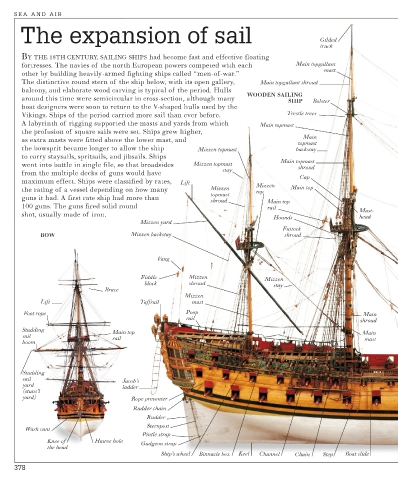
       BY THE 18TH CENTURY, SAILING SHIPS had become fast and effective floating
       fortresses. The navies of the north European powers competed with each      Main topgallant
       other by building heavily-armed fighting ships called “men-of-war.”                 mast
       The distinctive round stern of the ship below, with its open gallery,   Main topgallant shroud
       balcony, and elaborate wood carving is typical of the period. Hulls
                                                                      WOODEN SAILING
       around this time were semicircular in cross-section, although many        SHIP   Bolster
       boat designers were soon to return to the V-shaped hulls used by the
       Vikings. Ships of the period carried more sail than ever before.          Trestle trees
       A labyrinth of rigging supported the masts and yards from which   Main topmast
       the profusion of square sails were set. Ships grew higher,
       as extra masts were fitted above the lower mast, and                          Main
                                                                                    topmast
       the bowsprit became longer to allow the ship     Mizzen topmast             backstay
       to carry staysails, spritsails, and jibsails. Ships
                                                                               Main topmast
       went into battle in single file, so that broadsides   Mizzen topmast         shroud
                                                               stay
       from the multiple decks of guns would have
                                                                                    Cap
       maximum effect. Ships were classified by rates,   Lift           Mizzen
       the rating of a vessel depending on how many         Mizzen      top       Main top
                                                            topmast
       guns it had. A first rate ship had more than
                                                            shroud         Main top
       100 guns. The guns fired solid round                                rail
       shot, usually made of iron.                                                                   Mast-
                                                                             Hounds                  head
                                        Mizzen yard
                                                                                Futtock
            BOW                      Mizzen backstay                            shroud
                                             Vang


                                        Fiddle       Mizzen                Mizzen
                                         block       shroud                  stay
                              Brace
                                                    Mizzen
            Lift                        Taffrail      mast
        Foot rope                                    Poop                                             Main
                                                     rail
                                                                                                     shroud
       Studding                 Main top                                                              Main
       sail                     rail                                                                  mast
       boom


       Studding
       sail                        Jacob’s
       yard                        ladder
       (stuns’l
       yard)                         Rope preventer
                                      Rudder chain
                                          Rudder
                                          Sternpost
        Wash cant
                                         Pintle strap
              Knee of      Hawse hole   Gudgeon strap
              the head
                                              Ship’s wheel  Binnacle box  Keel  Channel  Chain  Step  Boat slide
     378

