


Page 378 - (DK) The Ultimate Visual Dictionary 2nd Ed.
P. 378
SEA AND AIR

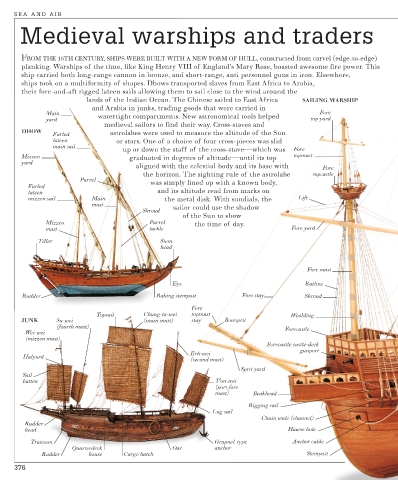
       Medieval warships and traders


       FROM THE 16TH CENTURY, SHIPS WERE BUILT WITH A NEW FORM OF HULL, constructed from carvel (edge-to-edge)
       planking. Warships of the time, like King Henry VIII of England’s Mary Rose, boasted awesome fire power. This
       ship carried both long-range cannon in bronze, and short-range, anti personnel guns in iron. Elsewhere,
       ships took on a multiformity of shapes. Dhows transported slaves from East Africa to Arabia,
       their fore-and-aft rigged lateen sails allowing them to sail close to the wind around the
                         lands of the Indian Ocean. The Chinese sailed to East Africa   SAILING WARSHIP
                           and Arabia in junks, trading goods that were carried in
              Main          watertight compartments. New astronomical tools helped        Fore
              yard                                                                     top yard
                              medieval sailors to find their way. Cross-staves and
       DHOW                     astrolabes were used to measure the altitude of the Sun
                Furled
                lateen           or stars. One of a choice of four cross-pieces was slid
                main sail
                                   up or down the staff of the cross-stave—which was   Fore
       Mizzen                        graduated in degrees of altitude—until its top   topmast
       yard
                                       aligned with the celestial body and its base with   Fore
                                         the horizon. The sighting rule of the astrolabe   topcastle
                       Parrel              was simply lined up with a known body,
         Furled
         lateen                              and its altitude read from marks on
         mizzen sail      Main                 the metal disk. With sundials, the   Lift
                          mast
                                         Shroud  sailor could use the shadow
                                                    of the Sun to show
              Mizzen                       Parrel      the time of day.
              mast                         tackle                                 Fore yard

            Tiller                            Stem
                                              head

                                                                                      Fore mast

                                                 Eye                                  Ratline
       Rudder                               Raking stempost         Fore stay         Shroud
                                                      Fore
                            Topsail      Chung-ta-wei   topmast                   Woolding
       JUNK      Su-wei                  (main mast)  stay     Bowsprit
                 (fourth mast)                                                  Forecastle
        Wei-wei
        (mizzen mast)
                                                                           Forecastle castle-deck
                                                                                    gunport
                                                      Erh-wei
       Halyard
                                                      (second mast)
                                                                    Sprit yard
       Sail
       batten                                                T’on-wei
                                                             (port fore -
                                                             mast)     Beakhead
                                                                      Rigging rail
                                                            Lug sail
                                                                          Chain wale (channel)
        Rudder
        head                                                                     Hawse hole
          Transom                                            Grapnel-type         Anchor cable
                     Quarterdeck                 Oar         anchor
             Rudder       house    Cargo hatch                                        Stempost

     376

