


Page 402 - (DK) The Ultimate Visual Dictionary 2nd Ed.
P. 402
SEA AND AIR

       Early monoplanes


                                    MONOPLANES HAVE ONE WING on each side of the fuselage. The principal
                                    disadvantage of this arrangement in early, wooden-framed aircraft was
                                    that single wings were weak and required strong wires to brace them to king
                                    posts above and below the fuselage. However, single wings also had advantages:
                                    they experienced less drag than multiple wings, allowing greater speed; they
                                    also made aircraft more manoeuvrable because single wings were easier to
                                    warp (twist) than double wings, and warping the wings was how pilots
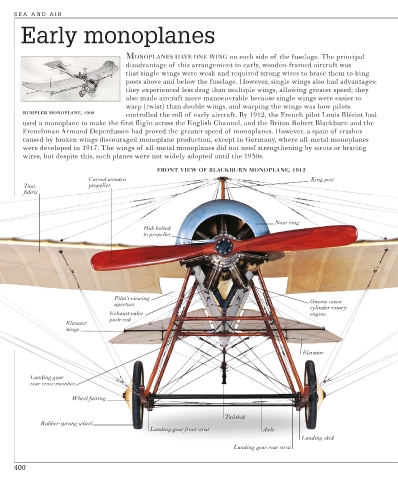
       RUMPLER MONOPLANE, 1908      controlled the roll of early aircraft. By 1912, the French pilot Louis Blériot had
       used a monoplane to make the first flight across the English Channel, and the Briton Robert Blackburn and the
       Frenchman Armand Deperdussin had proved the greater speed of monoplanes. However, a spate of crashes
       caused by broken wings discouraged monoplane production, except in Germany, where all-metal monoplanes
       were developed in 1917. The wings of all-metal monoplanes did not need strengthening by struts or bracing
       wires, but despite this, such planes were not widely adopted until the 1930s.
                                             FRONT VIEW OF BLACKBURN MONOPLANE, 1912
                          Carved wooden                                                King post
        Taut              propeller
        fabric


                                                                             Nose-ring
                                         Hub bolted
                                         to propeller


                                 Pilot’s viewing
                                 aperture                                              Gnome seven-
                                                                                       cylinder rotary
                               Exhaust valve                                           engine
                               push-rod
                   Elevator
                   hinge


                                                                                     Elevator


         Landing gear
         rear cross-member

                     Wheel fairing

                                                                Tailskid
            Rubber-sprung wheel
                                           Landing gear front strut       Axle
                                                                                     Landing skid
                                                                  Landing gear rear strut


     400

