


Page 404 - (DK) The Ultimate Visual Dictionary 2nd Ed.
P. 404
SEA AND AIR

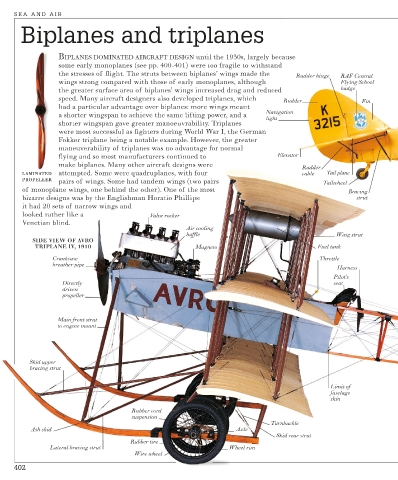
       Biplanes and triplanes


                 BIPLANES DOMINATED AIRCRAFT DESIGN until the 1930s, largely because
                 some early monoplanes (see pp. 400-401) were too fragile to withstand
                 the stresses of flight. The struts between biplanes’ wings made the   Rudder hinge  RAF Central
                 wings strong compared with those of early monoplanes, although                 Flying School
                 the greater surface area of biplanes’ wings increased drag and reduced         badge
                 speed. Many aircraft designers also developed triplanes, which   Rudder             Fin
                 had a particular advantage over biplanes: more wings meant
                                                                           Navigation
                 a shorter wingspan to achieve the same lifting power, and a
                                                                           light
                 shorter wingspan gave greater manoeuvrability. Triplanes
                 were most successful as fighters during World War I, the German
                 Fokker triplane being a notable example. However, the greater
                 maneuverability of triplanes was no advantage for normal
                 flying and so most manufacturers continued to                Elevator
                 make biplanes. Many other aircraft designs were                     Rudder
       LAMINATED   attempted. Some were quadruplanes, with four                      cable  Tail plane
       PROPELLER
                 pairs of wings. Some had tandem wings (two pairs                          Tailwheel
       of monoplane wings, one behind the other). One of the most                                 Bracing
       bizarre designs was by the Englishman Horatio Phillips:                                      strut
       it had 20 sets of narrow wings and
       looked rather like a                Valve rocker
       Venetian blind.
                                                     Air cooling
                                                     baffle                                   Wing strut
          SIDE VIEW OF AVRO
           TRIPLANE IV, 1910                           Magneto                           Fuel tank
                Crankcase                                                                 Throttle
                breather pipe
                                                                                               Harness
                                                                                              Pilot’s
                  Directly                                                                    seat
                  driven
                  propeller


                 Main front strut
                 to engine mount


         Skid upper
         bracing strut

                                                                                             Limit of
                                                                                             fuselage
                                                                                             skin
                                      Rubber cord
                                      suspension
                                                                            Turnbuckle
          Ash skid                                                 Axle
                                                                              Skid rear strut
                                     Rubber tire
               Lateral bracing strut                             Wheel rim
                                      Wire wheel

     402

