


Page 406 - (DK) The Ultimate Visual Dictionary 2nd Ed.
P. 406
SEA AND AIR

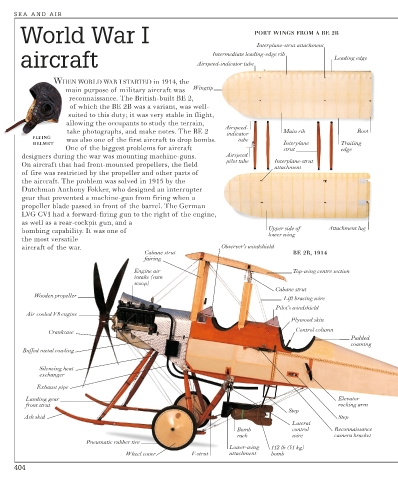
       World War I                                                      PORT WINGS FROM A BE 2B

                                                                        Interplane-strut attachment
       aircraft                                         Airspeed-indicator tube               Leading edge
                                                            Intermediate leading-edge rib


                WHEN WORLD WAR I STARTED in 1914, the
                   main purpose of military aircraft was   Wingtip
                    reconnaissance. The British-built BE 2,
                    of which the BE 2B was a variant, was well-
                    suited to this duty; it was very stable in flight,
                   allowing the occupants to study the terrain,
                                                                Airspeed-
                    take photographs, and make notes. The BE 2   indicator      Main rib            Root
          FLYING   was also one of the first aircraft to drop bombs.   tube
          HELMET                                                                Interplane      Trailing
                   One of the biggest problems for aircraft                     strut           edge
       designers during the war was mounting machine-guns.      Airspeed
                                                                pilot tube   Interplane-strut
       On aircraft that had front-mounted propellers, the field
                                                                             attachment
       of fire was restricted by the propeller and other parts of
       the aircraft. The problem was solved in 1915 by the
       Dutchman Anthony Fokker, who designed an interrupter
       gear that prevented a machine-gun from firing when a
       propeller blade passed in front of the barrel. The German
       LVG CVI had a forward-firing gun to the right of the engine,
       as well as a rear-cockpit gun, and a
                                                                            Upper side of    Attachment lug
       bombing capability. It was one of
                                                                            lower wing
       the most versatile
       aircraft of the war.                                   Observer’s windshield
                                         Cabane strut                             BE 2B, 1914
                                         fairing
                                      Engine air                                  Top-wing centre section
                                      intake (ram
                                      scoop)
                                                                             Cabane strut
           Wooden propeller
                                                                                Lift bracing wire
                                                                              Pilot’s windshield
        Air-cooled V8 engine
                                                                                  Plywood skin
                                                                                   Control column
              Crankcase
                                                                                                  Padded
                                                                                                  coaming
       Buffed metal cowling

            Silencing heat
            exchanger
           Exhaust pipe
        Landing gear                                                                           Elevator
        front strut                                                                            rocking arm
                                                                                 Step
        Ash skid                                                                               Step
                                                                                  Lateral
                                                                   Bomb           control     Reconnaissance
                                                                   rack           wire        camera bracket
                         Pneumatic rubber tire
                                                                 Lower-wing   112 lb (51 kg)
                                    Wheel cover       V-strut    attachment  bomb

     404

