


Page 428 - (DK) The Ultimate Visual Dictionary 2nd Ed.
P. 428
SEA AND AIR

       Gliders, hang-gliders,                                                           NOSE SHELL


       and ultralights                                                          Grommet for front   Instrument
                                                                                                 panel
                                                                                pylon strut

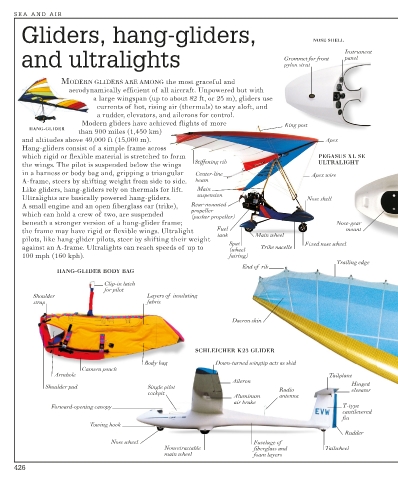
                  MODERN GLIDERS ARE AMONG the most graceful and
                    aerodynamically efficient of all aircraft. Unpowered but with
                           a large wingspan (up to about 82 ft, or 25 m), gliders use
                            currents of hot, rising air (thermals) to stay aloft, and
                            a rudder, elevators, and ailerons for control.
                        Modern gliders have achieved flights of more            King post
         HANG-GLIDER
                       than 900 miles (1,450 km)
       and altitudes above 49,000 ft (15,000 m).                                           Apex
       Hang-gliders consist of a simple frame across
       which rigid or flexible material is stretched to form                             PEGASUS XL SE
                                                       Stiffening rib                    ULTRALIGHT
       the wings. The pilot is suspended below the wings
       in a harness or body bag and, gripping a triangular   Center-line                Apex wire
       A-frame, steers by shifting weight from side to side.   beam
       Like gliders, hang-gliders rely on thermals for lift.   Main
                                                        suspension
       Ultralights are basically powered hang-gliders.                                Nose shell
       A small engine and an open fiberglass car (trike),   Rear-mounted
                                                      propeller
       which can hold a crew of two, are suspended
                                                      (pusher propeller)
       beneath a stronger version of a hang-glider frame;                                     Nose-gear
       the frame may have rigid or flexible wings. Ultralight    Fuel                            mount
                                                             tank       Main wheel
       pilots, like hang-glider pilots, steer by shifting their weight
                                                                 Spat                 Fixed nose wheel
       against an A-frame. Ultralights can reach speeds of up to   (wheel   Trike nacelle
       100 mph (160 kph).                                        fairing)
                                                                                              Trailing edge
                                                                    End of  rib
                 HANG-GLIDER BODY BAG
                              Clip-in latch
                              for pilot
          Shoulder                        Layers of  insulating
          strap                           fabric
                                                                 Dacron skin


                                                       SCHLEICHER K23 GLIDER

                                         Body bag            Down-turned wingtip acts as skid
                        Camera pouch
                Armhole                                                                     Tailplane
                                                                  Aileron
              Shoulder pad                Single pilot                         Radio               Hinged
                                          cockpit                                                  elevator
                                                                  Aluminum     antenna
                                                                  air brake
               Forward-opening canopy                                                           T-type
                                                                                                cantilevered
                                                                                                fin
                          Towing hook
                                                                                                 Rudder
                                Nose wheel                             Fuselage of
                                               Nonretractable          fiberglass and      Tailwheel
                                               main wheel              foam layers

     426

