


Page 452 - (DK) The Ultimate Visual Dictionary 2nd Ed.
P. 452
THE VISUAL AR TS

       Mosaic                                                        EQUIPMENT FOR BREAKING MARBLE

                                                                  Sawn strip of                     Mosaic
                                                                  marble, ready                     hammer
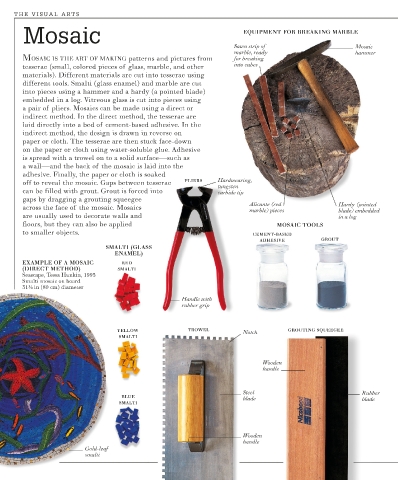
       MOSAIC IS THE ART OF MAKING patterns and pictures from     for breaking
       tesserae (small, colored pieces of glass, marble, and other   into cubes
       materials). Different materials are cut into tesserae using
       different tools. Smalti (glass enamel) and marble are cut
       into pieces using a hammer and a hardy (a pointed blade)
       embedded in a log. Vitreous glass is cut into pieces using
       a pair of pliers. Mosaics can be made using a direct or
       indirect method. In the direct method, the tesserae are
       laid directly into a bed of cement-based adhesive. In the
       indirect method, the design is drawn in reverse on
       paper or cloth. The tesserae are then stuck face-down
       on the paper or cloth using water-soluble glue. Adhesive
       is spread with a trowel on to a solid surface—such as
       a wall—and the back of the mosaic is laid into the
       adhesive. Finally, the paper or cloth is soaked
       off to reveal the mosaic. Gaps between tesserae   PLIERS  Hardwearing,
                                                             tungsten
       can be filled with grout. Grout is forced into        carbide tip
       gaps by dragging a grouting squeegee
                                                                      Alicante (red            Hardy (pointed
       across the face of the mosaic. Mosaics
                                                                      marble) pieces           blade) embedded
       are usually used to decorate walls and                                                  in a log
       floors, but they can also be applied                                   MOSAIC TOOLS
       to smaller objects.                                             CEMENT-BASED
                                                                         ADHESIVE         GROUT
                              SMALTI (GLASS
                                 ENAMEL)
       EXAMPLE OF A MOSAIC         RED
       (DIRECT METHOD)            SMALTI
       Seascape, Tessa Hunkin, 1993
       Smalti mosaic on board
       31½ in (80 cm) diameter

                                                   Handle with
                                                   rubber grip


                                  YELLOW             TROWEL         Notch        GROUTING SQUEEGEE
                                  SMALTI


                                                                          Wooden
                                                                          handle


                                                                    Steel                             Rubber
                                   BLUE
                                                                    blade                             blade
                                  SMALTI


                                                                    Wooden
                                                                    handle
                         Gold-leaf
                         smalti

