


Page 460 - (DK) The Ultimate Visual Dictionary 2nd Ed.
P. 460
ARCHITECTURE

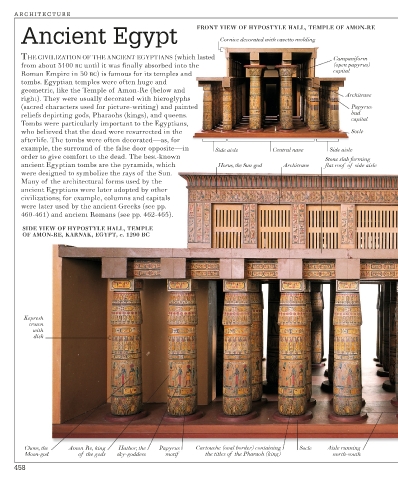
       Ancient Egypt                                    FRONT VIEW OF HYPOSTYLE HALL, TEMPLE OF AMON-RE
                                                              Cornice decorated with cavetto molding


       THE CIVILIZATION OF THE ANCIENT EGYPTIANS (which lasted                                Campaniform
       from about 3100 bc until it was finally absorbed into the                              (open papyrus)
                                                                                              capital
       Roman Empire in 30 bc) is famous for its temples and
       tombs. Egyptian temples were often huge and
       geometric, like the Temple of Amon-Re (below and
                                                                                                 Architrave
       right). They were usually decorated with hieroglyphs
       (sacred characters used for picture-writing) and painted                                    Papyrus-
       reliefs depicting gods, Pharaohs (kings), and queens.                                       bud
                                                                                                   capital
       Tombs were particularly important to the Egyptians,
       who believed that the dead were resurrected in the                                          Socle
       afterlife. The tombs were often decorated—as, for
       example, the surround of the false door opposite—in   Side aisle      Central nave    Side aisle
       order to give comfort to the dead. The best-known
                                                                                           Stone slab forming
       ancient Egyptian tombs are the pyramids, which         Horus, the Sun-god  Architrave  flat roof  of  side aisle
       were designed to symbolize the rays of the Sun.
       Many of the architectural forms used by the
       ancient Egyptians were later adopted by other
       civilizations; for example, columns and capitals
       were later used by the ancient Greeks (see pp.
       460-461) and ancient Romans (see pp. 462-465).
       SIDE VIEW OF HYPOSTYLE HALL, TEMPLE
       OF AMON-RE, KARNAK, EGYPT, c. 1290 BC


        Kepresh
         crown
          with
          disk


        Chons, the   Amon-Re, king   Hathor, the   Papyrus   Cartouche (oval border) containing   Socle  Aisle running
        Moon-god       of  the gods  sky-goddess  motif   the titles of  the Pharaoh (king)  north-south

     458

