


Page 464 - (DK) The Ultimate Visual Dictionary 2nd Ed.
P. 464
ARCHITECTURE

       Ancient Rome 1                                           ANCIENT ROMAN BUILDING DECORATION


       IN THE EARLY PERIOD OF THE ROMAN EMPIRE extensive use
       was made of ancient Greek architectural ideas, particularly
       those of the Corinthian order (see pp. 460-461). As a result,
       many early Roman buildings—such as the Temple of Vesta
       (opposite)—closely resemble ancient Greek buildings. A
                                                               FESTOON, TEMPLE OF VESTA,   RICHLY DECORATED
       distinctive Roman style began to evolve in the first century   TIVOLI, ITALY, C.80 BC  ROMAN OVUM
       AD. This style developed the interiors of buildings (the Greeks
       had concentrated on the exterior) by using arches, vaults, and
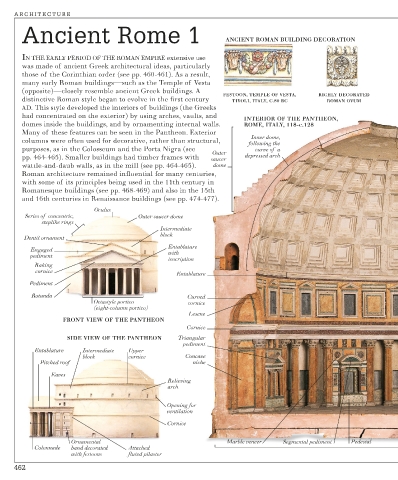
                                                                     INTERIOR OF THE PANTHEON,
       domes inside the buildings, and by ornamenting internal walls.   ROME, ITALY, 118-c.128
       Many of these features can be seen in the Pantheon. Exterior
                                                                       Inner dome,
       columns were often used for decorative, rather than structural,
                                                                      following the
       purposes, as in the Colosseum and the Porta Nigra (see           curve of  a
                                                            Outer
       pp. 464-465). Smaller buildings had timber frames with   saucer   depressed arch
       wattle-and-daub walls, as in the mill (see pp. 464-465).   dome
       Roman architecture remained influential for many centuries,
       with some of its principles being used in the 11th century in
       Romanesque buildings (see pp. 468-469) and also in the 15th
       and 16th centuries in Renaissance buildings (see pp. 474-477).
                           Oculus
        Series of  concentric,         Outer saucer dome
             steplike rings
                                              Intermediate
                                              block
        Dentil ornament
                                                Entablature
         Engaged                                with
         pediment
                                                inscription
           Raking
           cornice
                                                  Entablature
         Pediment
          Rotunda                                    Curved
                           Octastyle portico         cornice
                           (eight-column portico)
                                                     Lesene
                   FRONT VIEW OF THE PANTHEON
                                                     Cornice
                    SIDE VIEW OF THE PANTHEON     Triangular
                                                    pediment
           Entablature  Intermediate   Upper
                        block        cornice        Concave
            Pitched roof                               niche
               Eaves
                                                Relieving
                                                arch

                                               Opening for
                                               ventilation
                                               Cornice

                     Ornamental                                 Marble veneer   Segmental pediment  Pedestal
           Colonnade  band decorated   Attached
                     with festoons   fluted pilaster

     462

