


Page 462 - (DK) The Ultimate Visual Dictionary 2nd Ed.
P. 462
ARCHITECTURE

       Ancient Greece                                           CAPITALS OF THE THREE ORDERS OF
                                                                  ANCIENT GREEK ARCHITECTURE

                                                                                                 Abacus
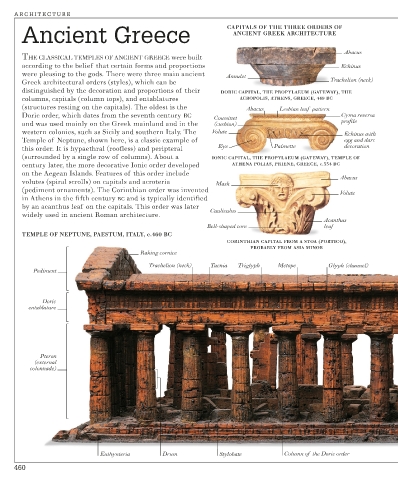
       THE CLASSICAL TEMPLES OF ANCIENT GREECE were built
       according to the belief that certain forms and proportions                               Echinus
       were pleasing to the gods. There were three main ancient   Annulet
       Greek architectural orders (styles), which can be                                     Trachelion (neck)
       distinguished by the decoration and proportions of their   DORIC CAPITAL, THE PROPYLAEUM (GATEWAY), THE
       columns, capitals (column tops), and entablatures            ACROPOLIS, ATHENS, GREECE, 449 BC
       (structures resting on the capitals). The oldest is the       Abacus    Lesbian leaf  pattern
       Doric order, which dates from the seventh century BC                                     Cyma reversa
                                                            Coussinet
       and was used mainly on the Greek mainland and in the   (cushion)                         profile
       western colonies, such as Sicily and southern Italy. The   Volute                         Echinus with
       Temple of Neptune, shown here, is a classic example of                                    egg and dart
       this order. It is hypaethral (roofless) and peripteral   Eye          Palmette            decoration
       (surrounded by a single row of columns). About a     IONIC CAPITAL, THE PROPYLAEUM (GATEWAY), TEMPLE OF
       century later, the more decorative Ionic order developed   ATHENA POLIAS, PRIENE, GREECE, c.334 BC
       on the Aegean Islands. Features of this order include                                   Abacus
       volutes (spiral scrolls) on capitals and acroteria    Mask
       (pediment ornaments). The Corinthian order was invented
                                                                                               Volute
       in Athens in the fifth century bc and is typically identified
       by an acanthus leaf on the capitals. This order was later   Cauliculus
       widely used in ancient Roman architecture.
                                                                                           Acanthus
                                                           Bell-shaped core                leaf
       TEMPLE OF NEPTUNE, PAESTUM, ITALY, c.460 BC
                                                                CORINTHIAN CAPITAL FROM A STOA (PORTICO),
                                                                       PROBABLY FROM ASIA MINOR
                                        Raking cornice
                                          Trachelion (neck)  Taenia  Triglyph  Metope       Glyph (channel)
          Pediment


             Doric
         entablature


            Pteron
           (external
         colonnade)


                             Euthynteria      Drum            Stylobate         Column of  the Doric order

     460

