


Page 468 - (DK) The Ultimate Visual Dictionary 2nd Ed.
P. 468
ARCHITECTURE

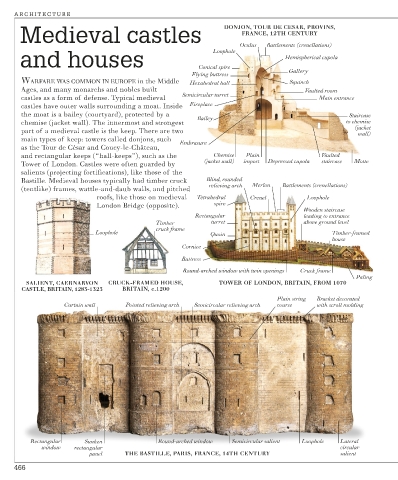
       Medieval castles                                        DONJON, TOUR DE CESAR, PROVINS,
                                                                    FRANCE, 12TH CENTURY
                                                                    Oculus  Battlements (crenellations)
                                                            Loophole
       and houses                                                               Hemispherical cupola
                                                        Conical spire
                                                                                 Gallery
                                                      Flying buttress
       WARFARE WAS COMMON IN EUROPE in the Middle     Hexahedral hall            Squinch
       Ages, and many monarchs and nobles built                                       Vaulted room
                                                    Semicircular turret
       castles as a form of defense. Typical medieval                                     Main entrance
       castles have outer walls surrounding a moat. Inside   Fireplace
       the moat is a bailey (courtyard), protected by a                                           Staircase
                                                        Bailey
       chemise (jacket wall). The innermost and strongest                                        to chemise
                                                                                                   (jacket
       part of a medieval castle is the keep. There are two
                                                                                                    wall)
       main types of keep: towers called donjons, such
                                                   Embrasure
       as the Tour de César and Coucy-le-Château,
       and rectangular keeps (“hall-keeps”), such as the    Chemise   Plain               Vaulted
                                                          (jacket wall)  impost  Depressed cupola  staircase  Motte
       Tower of London. Castles were often guarded by
       salients (projecting fortifications), like those of the
       Bastille. Medieval houses typically had timber cruck   Blind, rounded
                                                           relieving arch  Merlon  Battlements (crenellations)
       (tentlike) frames, wattle-and-daub walls, and pitched
                            roofs, like those on medieval   Tetrahedral   Crenel      Loophole
                            London Bridge (opposite).       spire
                                                                                     Wooden staircase
                                                       Rectangular                   leading to entrance
                                            Timber          turret                   above ground level
                                            cruck frame
                            Loophole                       Quoin                             Timber-framed
                                                                                             house
                                                    Cornice
                                                   Buttress
                                                    Round-arched window with twin openings  Cruck frame
                                                                                                    Paling
        SALIENT, CAERNARVON    CRUCK-FRAMED HOUSE,            TOWER OF LONDON, BRITAIN, FROM 1070
       CASTLE, BRITAIN, 1283-1323  BRITAIN, c.1200
                                                                              Plain string   Bracket decorated
                   Curtain wall     Pointed relieving arch  Semicircular relieving arch  course  with scroll molding


         Rectangular     Sunken              Round-arched window  Semicircular salient  Loophole  Lateral
             window   rectangular                                                              circular
                          panel     THE BASTILLE, PARIS, FRANCE, 14TH CENTURY                  salient

     466

